
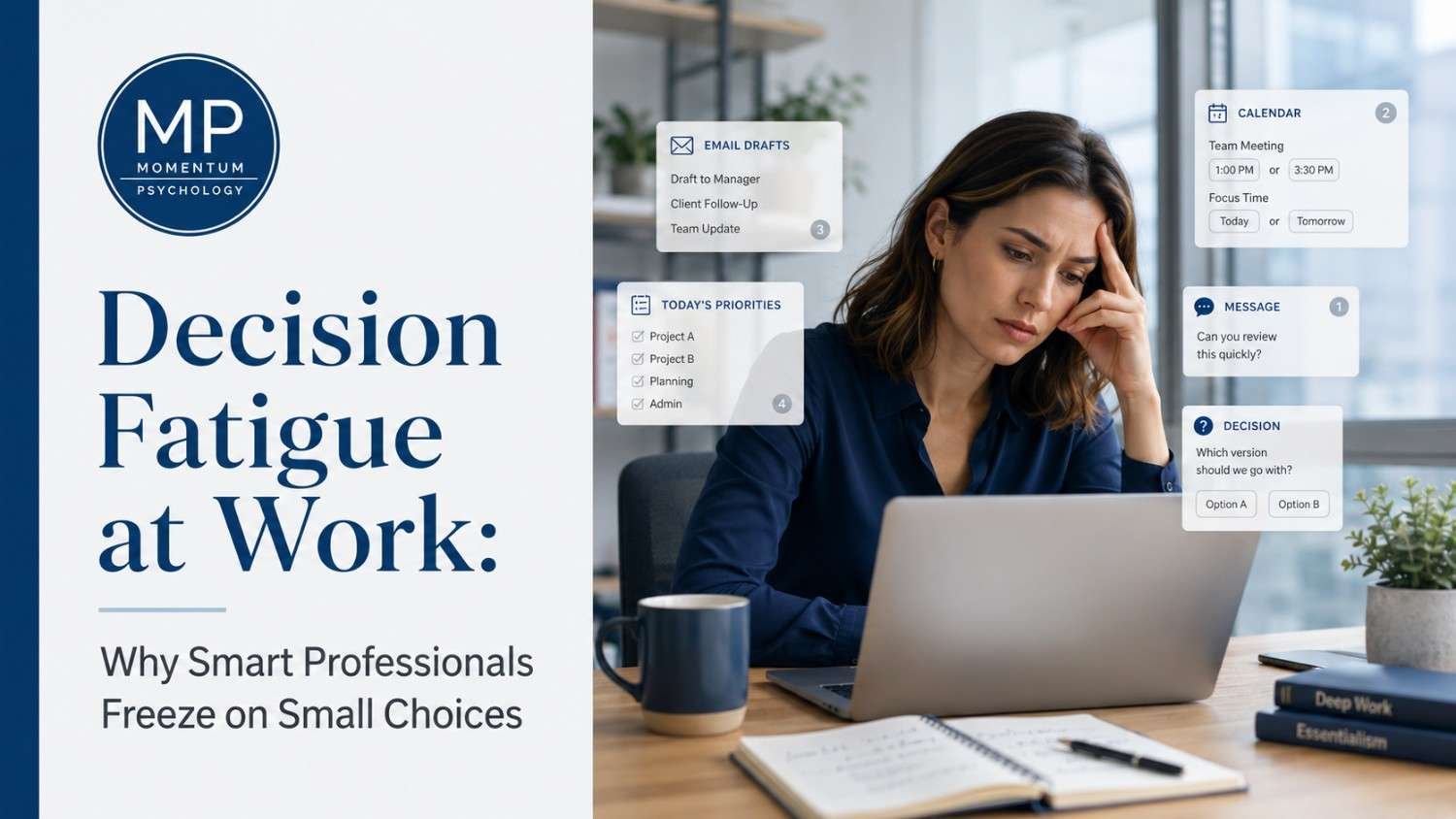
Decision fatigue at work happens when repeated choices, ambiguity, pressure, and emotional load make even small decisions feel harder than they should. Smart, capable professionals can freeze on simple choices not because they lack intelligence, but because their cognitive load is already too high. High-achieving professionals may be especially vulnerable because they often carry urgency, responsibility, perfectionism, and pressure to make the “right” call. Momentum Psychology provides doctoral-level online therapy for high-achieving professionals dealing with stress, anxiety, burnout, ADHD-related executive function challenges, and workplace pressure.
This article is educational and not a substitute for care from a qualified mental health professional.
What Is Decision Fatigue at Work?
Decision fatigue at work is the mental depletion or reduced decision capacity that can happen after repeated decisions, ambiguous choices, emotional pressure, or prolonged cognitive effort.
It can show up when a normally competent professional gets stuck on questions like:
- Which email should I answer first?
- Should I send this now or revise it again?
- Which task matters most today?
- Should I speak up in this meeting?
- Is this good enough?
- Should I delegate this or handle it myself?
Decision fatigue is not laziness. It is not low intelligence. It is not always a mental health diagnosis. It may overlap with stress, anxiety, burnout, ADHD, perfectionism, sleep deprivation, depression, excessive workload, or major life transitions.
A PMC/NIH-hosted conceptual analysis of decision fatigue discusses decision fatigue as a relevant concept in health sciences and decision-making contexts, especially when repeated decision demands affect cognitive, behavioral, or physiological functioning. This article uses the term in that practical sense — not as a formal diagnosis.
The core issue is simple: the brain has limited capacity for high-quality decisions without rest, clarity, prioritization, and emotional recovery.
Why Smart Professionals Freeze on Small Choices
Smart professionals often freeze on small choices because the decision is not actually “small” inside their nervous system. It may carry hidden pressure.
A short email can feel like a reputation risk. A minor deadline can feel like proof of competence. A simple priority choice can become a test of whether you are organized, reliable, strategic, and valuable.
Decision fatigue in professionals may be driven by:
- Too many decisions in one day
- Too many options with unclear tradeoffs
- High consequences attached to small choices
- Fear of making the wrong call
- Perfectionism
- Lack of recovery time
- Constant interruptions
- Digital overload
- Ambiguous expectations
- Over-responsibility
- Emotional labor
- Job insecurity or organizational uncertainty
This is why decision fatigue at work is common among high-achieving professionals. They are often rewarded for accuracy, responsiveness, and judgment. But when every decision feels like it matters, the mind eventually starts resisting even routine choices.
Momentum’s therapy for busy professionals is designed for adults who are externally capable but may be internally carrying stress, anxiety, over-responsibility, or decision-making pressure.
Decision Fatigue vs Healthy Deliberation
Healthy deliberation helps you think clearly. Decision fatigue makes thinking feel heavy, repetitive, and harder to complete.
| Situation | Healthy Deliberation | Decision Fatigue Pattern |
| Choosing where to start | You identify the most important or time-sensitive task. | Everything feels equally urgent, and you avoid starting. |
| Replying to an email | You answer clearly and move on. | You reread and rewrite the message repeatedly. |
| Prioritizing tasks | You choose based on impact, deadline, or energy. | You keep reorganizing the list instead of taking action. |
| Making a low-stakes decision | You choose a reasonable option. | You treat the choice as if it has major consequences. |
| Receiving unclear instructions | You ask for clarification. | You try to guess perfectly and carry the ambiguity alone. |
| Choosing between two reasonable options | You pick one and adjust if needed. | You keep comparing until both options feel wrong. |
| Ending the workday | You stop when the day is complete enough. | You keep working because stopping feels unsafe. |
| Delegating a task | You assign it with expectations. | You hold onto it because quality loss feels too risky. |
The goal is not to make every decision instantly. The goal is to match the amount of thinking to the real stakes of the choice.
Common Signs of Decision Fatigue at Work
Decision fatigue often looks like procrastination from the outside. Internally, it may feel like mental gridlock.
Common signs include:
- Freezing on small choices
- Re-reading the same message repeatedly
- Asking for reassurance on low-stakes decisions
- Avoiding decisions until they become urgent
- Choosing the easiest option just to be done
- Irritability when asked one more question
- Feeling mentally foggy late in the day
- Procrastinating on simple tasks
- Overthinking minor details
- Difficulty prioritizing
- Decision paralysis after meetings
- Feeling exhausted from “thinking,” not just doing
- Needing excessive certainty before acting
- Making impulsive choices after a long day
- Reopening decisions that were already made
- Feeling guilty for needing rest
Decision-making anxiety can also intensify the pattern. When every option feels risky, the brain may keep searching for certainty before acting. Anxiety therapy may help when decision-making is driven by fear, rumination, reassurance-seeking, or catastrophic predictions.
If decision fatigue is showing up as low energy, procrastination, or feeling stuck, Momentum’s related guide on how to regain motivation at work may also be useful.
Why Decision Fatigue Is Worse for High Achievers
High achievers often do not experience decisions as neutral. They experience them as evidence.
A small choice may seem to say something about intelligence, discipline, leadership, competence, or worth. That is a heavy load for a small decision to carry.
High achievers may be more vulnerable because they often:
- Turn every decision into a performance test
- Assume every choice reveals competence
- Carry responsibility for other people’s outcomes
- Feel pressure to be fast and correct
- Over-optimize small decisions
- Struggle to delegate because they fear quality loss
- Confuse exhaustion with personal weakness
- Believe they should be able to “handle it”
- Feel ashamed when simple choices become hard
This is the trap: the more capable you are, the more likely others are to bring you decisions. Over time, being trusted can become overloaded.
The question is not “Why can’t I handle this?” A better question is:
“How much decision load am I carrying, and where does that load need structure, support, or recovery?”
The Loop: Pressure, Overthinking, Avoidance, and Burnout
Decision fatigue at work often becomes a self-reinforcing loop.
- Work creates repeated decisions and unclear demands.
- You feel pressure to choose correctly.
- You overthink, delay, seek reassurance, or keep working.
- You feel short-term relief.
- More decisions pile up.
- Mental fatigue increases.
- Burnout risk rises.
This loop can be hard to interrupt because overthinking may feel responsible. Rechecking may feel careful. Delaying may feel safer than choosing. But each pattern can increase the mental cost of the next decision.
That is where stress and burnout therapy may help. The goal is not to make you careless. The goal is to reduce the unnecessary mental load that keeps your system running past capacity.
Workplace stress and job insecurity can make the loop worse. According to APA’s 2025 Work in America Survey, job insecurity significantly affected stress levels for more than half of U.S. workers. APA has also reported that high stress can make even basic decisions, such as what to wear or what to eat, feel difficult, according to its article on stress and decision-making.
If stress is the main driver, Momentum’s guide on how to manage stress effectively offers practical reset tools that can pair well with the strategies in this article.
Decision Fatigue, Anxiety, ADHD, and Burnout: How They Can Overlap
The same behavior — freezing on a small decision — can have different drivers.
For one person, the driver may be anxiety. For another, it may be ADHD-related executive function difficulty. For another, it may be burnout, depression, perfectionism, sleep deprivation, or sheer workload.
Here is how these patterns can overlap:
- Anxiety may make decisions feel risky because the mind keeps scanning for what could go wrong.
- ADHD may affect prioritizing, sequencing, task initiation, working memory, and switching between tasks.
- Burnout may reduce mental energy, emotional flexibility, and motivation.
- Perfectionism may make small choices feel high-stakes.
- Depression may reduce motivation, clarity, or confidence.
- Sleep deprivation can make executive function harder.
- Chronic stress can keep the body in a state of tension, making calm decision-making more difficult.
This distinction matters. If you only treat decision fatigue as a productivity problem, you may miss the real driver. A calendar template will not fully solve anxiety-based avoidance. A priority list will not fully solve burnout. A “just decide faster” rule may not help if ADHD-related executive function challenges are involved.
For adults who suspect attention, planning, prioritizing, or task initiation may be part of the pattern, ADHD therapy for adults may provide more targeted support.
What to Do When Decision Fatigue Takes Over
You do not need a perfect system. You need a system that reduces unnecessary decision load and helps you act when the stakes are low enough to act.
Lower the Stakes of Small Decisions
Not every decision deserves your full analytical power.
Ask:
- Is this reversible?
- Will this matter in one week?
- Is there a clearly wrong option?
- Would either choice be acceptable?
- Am I trying to avoid discomfort rather than make a better choice?
If the stakes are low, choose the good-enough option and move.
Create Default Rules for Repeat Choices
Defaults reduce decision load.
Examples:
- Check email at set times instead of continuously.
- Use the same meeting-prep template.
- Make Monday morning a planning block.
- Delegate recurring tasks using a standard checklist.
- Use a default response window for nonurgent messages.
- Choose a standard lunch or work uniform on high-load days.
Defaults are not rigid. They are mental energy protection.
Decide Earlier When Possible
Late-day decisions are often harder because your system has already spent hours processing information, emotions, and demands.
When possible, make important decisions earlier in the day. Save low-stakes admin for later.
Batch Similar Decisions
Decision switching is costly. Instead of making decisions all day, batch them:
- approvals
- emails
- scheduling
- project reviews
- financial decisions
- hiring or team decisions
- personal admin
Batching reduces the mental friction of shifting contexts.
Reduce Options Before Choosing
Too many options can increase decision paralysis at work.
Limit yourself to two or three reasonable choices. You are not looking for every possible option. You are looking for enough information to choose responsibly.
Separate Reversible From Irreversible Decisions
A reversible decision should not be treated like a life-defining decision.
Use this filter:
- Reversible: choose faster, learn, adjust.
- Hard to reverse: slow down, gather input, document reasoning.
- High-impact and uncertain: consult, clarify values, and define next steps.
Use Values Instead of Perfection as the Filter
Perfection asks, “What is the flawless choice?”
Values ask, “Which choice moves me toward the kind of person, professional, or leader I want to be?”
Momentum’s work with Acceptance and Commitment Therapy often focuses on values-based action — making meaningful choices even when uncertainty, discomfort, or fear is present. Momentum also has practical resources on values exercises and values-based decision-making that can help readers connect decisions to what matters instead of fear.
Protect Recovery Time
Decision fatigue is not only solved by better planning. It also requires recovery.
Protect:
- sleep
- movement
- time away from screens
- meals
- quiet transitions
- unscheduled time
- actual off-work hours
A depleted brain cannot systematize its way into endless capacity. If work and home responsibilities are both adding decision load, Momentum’s guide on managing work and family demands may also help.
Ask for Clarity Instead of Carrying Ambiguity
Ambiguity creates hidden decisions.
Instead of silently guessing, ask:
- “What is the priority here?”
- “What does success look like?”
- “Which tradeoff matters most?”
- “Is this urgent or can it wait?”
- “Who owns the final decision?”
- “What level of detail do you need?”
Clarity reduces unnecessary mental load.
Get Support When Decision Fatigue Becomes Persistent
If decision fatigue is affecting sleep, mood, relationships, performance, or health, support matters. That support may include therapy, medical care, coaching, mentorship, delegation, workload changes, or practical system design.
A Practical Decision Reset Plan for Work
| Moment | What Decision Fatigue Says | Better Response | Why It Helps |
| You do not know where to start | “Everything matters.” | Choose the highest-impact or most time-sensitive task. | Reduces overwhelm by creating a starting point. |
| You are choosing between two decent options | “One must be right.” | If both are acceptable and reversible, choose one. | Prevents over-optimization. |
| You keep rereading an email | “It might be wrong.” | Set a two-minute revision limit, then send. | Limits reassurance-seeking. |
| You are stuck after back-to-back meetings | “I should push through.” | Take five minutes to reset before deciding. | Supports clearer thinking. |
| You are deciding late in the day | “Why can’t I think?” | Move nonurgent decisions to tomorrow morning. | Matches decisions to better energy. |
| You are afraid of disappointing someone | “I need the perfect answer.” | Clarify expectations and make a reasonable choice. | Reduces mind-reading. |
| You are overwhelmed by too many options | “I need more information.” | Narrow to two or three options. | Prevents choice overload. |
| You are avoiding a decision | “I’ll do it later.” | Name the next tiny action. | Turns avoidance into movement. |
A 15-Minute System for Small Decisions
When you are stuck on a small decision, use this system.
1. Name the Decision
Write the decision in one sentence.
Example:
“Do I send this email now or revise it again?”
If you cannot name the decision, you are probably managing a cloud of anxiety rather than one choice.
2. Decide Whether It Is Reversible or Irreversible
Ask: “Can I adjust this later?”
Most daily work decisions are more reversible than they feel.
3. Limit Options to Two or Three
Too many options create noise. Reduce the field.
Example:
- Send now.
- Revise for five minutes, then send.
- Ask one clarifying question before sending.
4. Choose the Good-Enough Option if the Stakes Are Low
Good enough is not careless. It is proportional.
5. Set a Time Limit
Try 5, 10, or 15 minutes depending on the decision. When the timer ends, choose the best available option.
6. Identify the Next Action
A decision is not complete until it turns into action.
Examples:
- Send the email.
- Put the meeting on the calendar.
- Ask for clarification.
- Delegate the task.
- Move the item to tomorrow’s priority list.
7. Stop Reopening the Decision Unless New Information Appears
Reopening decisions drains energy. If no meaningful new information appears, practice letting the decision stay closed.
If rumination keeps pulling you back into already-made choices, Momentum’s defusion exercises can help you practice noticing thoughts without automatically obeying them.
When Decision Fatigue May Be a Sign to Seek Therapy
Therapy may help when decision fatigue becomes persistent, emotionally loaded, or difficult to interrupt alone.
Consider support if:
- You frequently freeze on small choices
- Anxiety, shame, or panic shows up around decisions
- You avoid decisions until they become crises
- Work stress affects sleep, mood, relationships, or health
- Perfectionism makes decisions feel unsafe
- ADHD-related executive function challenges may be involved
- Burnout makes everyday tasks feel unmanageable
- Career or life transitions are increasing uncertainty
- You feel unable to trust yourself even after reasonable preparation
For some professionals, online therapy makes support easier to access around demanding work schedules. Decision fatigue may also increase during career shifts, identity changes, relocation, graduation, leadership transitions, or uncertainty; in those cases, therapy for life transitions may help.
How Therapy Can Help Professionals With Decision Fatigue
Therapy does not promise to remove all uncertainty or make every choice easy. That would not be realistic.
Instead, therapy can help you understand what is driving the decision fatigue and build more flexible responses.
Therapy may help you:
- Identify the real driver behind decision fatigue
- Reduce rumination and reassurance-seeking
- Build decision-making systems
- Improve stress regulation
- Address perfectionism and fear of mistakes
- Strengthen boundaries and delegation
- Build tolerance for uncertainty
- Support ADHD-related executive functioning when relevant
- Reconnect decisions with values instead of fear
CBT may help identify catastrophic interpretations and all-or-nothing thinking. ACT may help build values-based decisions under uncertainty. DBT-informed skills may support emotional regulation. ADHD-focused therapy may support planning, prioritizing, and task initiation. Mindfulness and nervous-system regulation may support clearer decision-making.
The goal is not to become a machine that makes perfect decisions. The goal is to become a person who can make workable decisions without giving every choice to your entire nervous system.
Final Thoughts: Freezing on Small Choices Does Not Mean You Are Failing
Decision fatigue at work is not a character flaw. It is often a sign that cognitive load, stress, ambiguity, pressure, and emotional demand have exceeded available recovery.
Smart professionals freeze on small choices when too many decisions have carried too much weight for too long. The answer is not shame. The answer is structure, defaults, boundaries, values, recovery, and support.
Momentum Psychology provides doctoral-level online therapy for high-achieving professionals navigating stress, anxiety, burnout, ADHD-related executive function challenges, life transitions, and workplace pressure. If decision fatigue at work is affecting your sleep, focus, relationships, performance, or quality of life, you can start therapy.
FAQs About Decision Fatigue at Work
What is decision fatigue at work?
- Decision fatigue at work is the mental depletion that can happen after repeated choices, unclear demands, emotional pressure, or prolonged cognitive effort. It may make small decisions feel harder than they should. It is not laziness or low intelligence, and it is not always a mental health diagnosis.
Why do smart professionals freeze on small choices?
- Smart professionals often freeze because small choices can carry hidden pressure. A simple email, task, or priority decision may feel connected to competence, reputation, or responsibility. When cognitive load is already high, the brain may delay, overthink, or seek certainty before acting.
Is decision fatigue the same as burnout?
- Decision fatigue and burnout can overlap, but they are not the same. Decision fatigue refers to reduced decision capacity after repeated or stressful choices. Burnout is broader and may include emotional exhaustion, cynicism, reduced effectiveness, and difficulty recovering from ongoing stress.
Can anxiety cause decision fatigue?
- Anxiety can contribute to decision fatigue by making choices that feel risky or unsafe. When the mind keeps scanning for what could go wrong, even small decisions may require excessive mental effort. Therapy may help when decision-making is driven by worry, rumination, or reassurance-seeking.
Can ADHD make decision fatigue worse?
- ADHD can make decision fatigue worse for some adults because prioritizing, sequencing, task initiation, working memory, and switching between tasks may require extra effort. ADHD-related decision challenges are not a character flaw. Targeted support can help build practical systems and reduce shame.
How do I reduce decision fatigue at work?
- Reduce decision fatigue by creating defaults, batching similar choices, limiting options, deciding earlier in the day, separating reversible from irreversible decisions, and asking for clarity when expectations are vague. Recovery also matters. A tired brain has less capacity for flexible decision-making.
When should I seek therapy for decision fatigue?
- Consider therapy when decision fatigue is persistent, affects sleep or relationships, causes anxiety or shame, leads to avoidance, or makes everyday work feel unmanageable. Therapy may also help if perfectionism, burnout, ADHD-related executive function challenges, or major life transitions are involved.
Can therapy help with decision paralysis at work?
- Therapy may help with decision paralysis by identifying the underlying pattern, reducing rumination, building tolerance for uncertainty, improving stress regulation, and creating practical decision-making systems. It does not guarantee perfect decisions, but it can help you make choices with more clarity and less fear.