
If you have lost motivation at work, the problem is usually not laziness. It is more often a signal that something important has broken down — such as energy, autonomy, progress, meaning, support, or recovery. The fastest path back is to identify which of those is missing, fix one part of the system first, and treat burnout, anxiety, or depression seriously if they are part of the picture. WHO notes that work can protect mental health, but unhealthy working conditions — including excessive workload, low control, poor support, unclear roles, and job insecurity — can also damage it.
Read more: Is it Time to Consult an Anxiety Therapist? Signs You Shouldn’t Ignore
Why you lost motivation at work in the first place
Motivation at work tends to fall when one or more core needs are not being met. Self-Determination Theory is useful here because it explains work motivation through three psychological needs: autonomy (a sense of choice and control), competence (feeling capable and effective), and relatedness (feeling connected and supported). Recent workplace reviews continue to support those needs as major drivers of work motivation and work-related outcomes.
That means “I’m not motivated” is often shorthand for something more specific:
- “I have no control over how I work.”
- “I don’t feel good at this anymore.”
- “My work doesn’t feel meaningful.”
- “I’m exhausted and not recovering.”
- “I feel disconnected from my team or manager.”
When you name the real driver, motivation becomes much easier to rebuild. WHO’s workplace mental health guidance supports this system’s view by highlighting workload, low job control, poor communication, weak support, and organizational culture as psychosocial risks that affect functioning and mental health.
Read more: Managing Anxiety: Therapeutic Techniques for Success
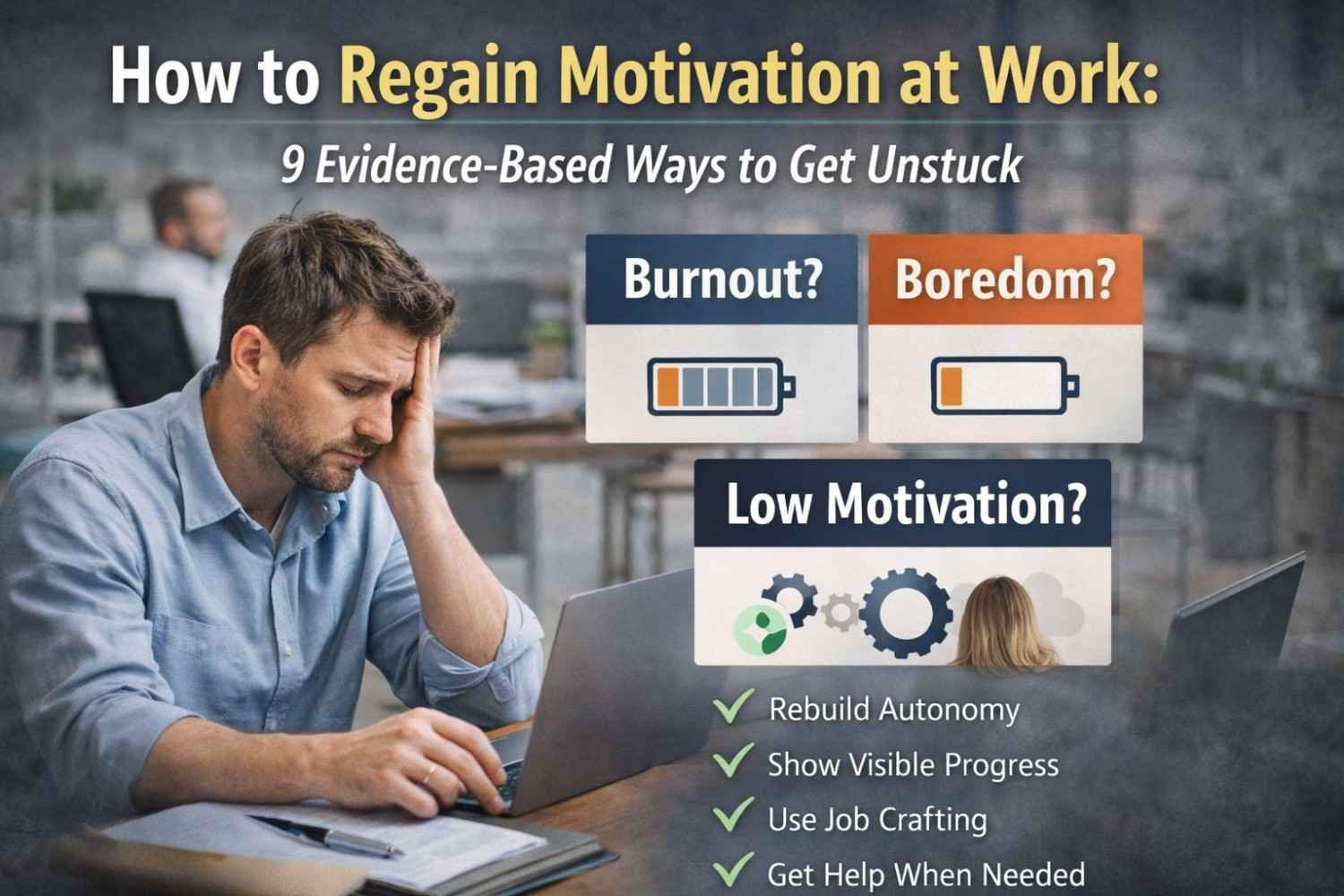
Burnout vs boredom vs low motivation
A lot of people call everything “burnout,” but that blurs the real problem.
Burnout is defined by WHO in ICD-11 as an occupational phenomenon resulting from chronic workplace stress that has not been successfully managed. It is characterized by three dimensions: energy depletion or exhaustion, increased mental distance from the job or feelings of negativism/cynicism, and reduced professional efficacy. It is not classified as a medical condition.
Boredom or disengagement looks different. You may not feel depleted; instead, you feel under-stimulated, flat, disconnected, or uninterested. You can still function, but work feels dull and emotionally dead. That usually points more toward poor fit, low challenge, low meaning, or low growth than classic burnout. The WHO framework helps here too, because both overload and under-stimulation can be part of unhealthy work design.
Low motivation can sit in the middle. You may still care about your job in theory, but you struggle to start, sustain, or finish meaningful work. That can come from burnout, boredom, anxiety, depression, perfectionism, lack of role clarity, or simply too little visible progress. The fix depends on which one is actually happening.
The 3 motivation needs your job has to meet
1) Autonomy
You do not need total freedom to feel motivated, but you usually need some sense of choice in how you approach your work. Research grounded in Self-Determination Theory repeatedly links autonomy support to better work motivation and healthier work outcomes.
2) Competence
Motivation grows when you feel capable, improving, and able to solve meaningful problems. When work becomes too chaotic, too ambiguous, or too misaligned with your strengths, motivation drops because professional efficacy drops with it. WHO’s burnout framing includes reduced professional efficacy for a reason.
3) Relatedness
People work better when they feel connected, respected, and supported. Isolation, poor leadership, team conflict, or constant psychological threat can steadily drain motivation even if the role itself is fine. SDT research consistently shows relatedness matters for work motivation and functioning.
9 evidence-based ways to regain motivation at work
1) Run a burnout check before you call it laziness
If your motivation drop comes with exhaustion, cynicism, or the sense that you are no longer effective, treat burnout as a real possibility. Calling burnout “low discipline” usually makes it worse because you respond with more pressure instead of better recovery and boundaries. WHO’s burnout definition gives you a useful self-check: am I depleted, mentally distant from work, and feeling less effective than I used to?
2) Shrink the task until progress is visible
Motivation often returns after action, not before it. One reason people get stuck is that their tasks are too vague or too large to create visible progress. Break one important project into the smallest meaningful next step and finish that before moving on. Research on work engagement and performance repeatedly shows that clarity and manageable goal structure support action and persistence.
3) Use job crafting to change the work around you
Job crafting means making small, deliberate changes to your tasks, relationships, or mindset so the job fits you better. A meta-analysis found job crafting is positively related to work engagement and related outcomes. That makes it one of the strongest practical levers in this article.
Start with one question: What part of this role can I shape this week?
That could mean protecting one deep-work block, asking to own a project type you are better at, reducing unnecessary meetings, or increasing contact with the part of the role that feels more meaningful.
4) Rebuild autonomy in one small area
If you cannot redesign your whole job, rebuild control in one narrow space. Choose one of these:
- when you do your hardest work
- how you structure a recurring task
- which process you streamline
- how you batch communication
Autonomy does not have to be dramatic to help. Small increases in control can improve motivation when low control is part of the problem. WHO’s workplace guidance specifically identifies low job control as a psychosocial risk.
5) Set one clear weekly outcome, not five vague goals
A common motivation killer is carrying too many undefined priorities at once. Pick one weekly outcome that is concrete enough to know whether it happened. “Make progress on the strategy deck” is weak. “Finish the first draft of slides 1–8 by Thursday at 3 p.m.” is better. Clear outcomes reduce mental friction and make progress visible.
6) Reconnect your work to a person, team, or real impact
Motivation drops when work feels abstract and detached from outcomes. Relatedness and meaning matter. Even if your role is not ideal, reconnecting it to a customer, patient, teammate, mission, or concrete downstream effect can restore some energy. SDT research links relatedness to stronger motivation; workplace meaning research also supports this mechanism.
7) Use manager support strategically instead of silently struggling
If you need clarity, feedback, role adjustment, or better prioritization, asking early is usually smarter than carrying silent resentment. WHO’s workplace guidance points to communication, support, and organizational conditions as central to mental health at work.
A useful script is:
“I’m noticing I’m getting stuck around priorities and energy. I want to improve output, but I need clarity on what matters most this week and what can drop.”
8) Protect recovery outside work
You cannot out-hack chronic depletion. If you are not recovering outside work, motivation strategies will only go so far. WHO’s workplace mental health guidance is clear that excessive workload and unmanaged stress harm mental health and performance. Recovery is not optional if burnout is part of the picture.
Protect three basics first:
- sleep consistency
- some movement
- at least one genuine off-work recovery window each day
9) Get help when low motivation is really anxiety, depression, or burnout
Sometimes motivation is not the main problem. It is the visible symptom of something deeper. WHO notes that depression and anxiety cause major loss of working days globally, and workplace conditions can worsen mental health. If your motivation loss comes with dread, self-criticism, hopelessness, panic, persistent exhaustion, or inability to recover, support may be the most effective next step.
What to do this week: a 15-minute motivation reset
If you want a simple reset, use this:
Spend 5 minutes identifying the real problem:
- Is this exhaustion?
- Is this boredom?
- Is this overload?
- Is this poor fit?
- Is this anxiety or perfectionism?
Spend 5 minutes choosing one visible progress task:
- something small enough to finish
- important enough to matter
- clear enough to define
Spend 5 minutes choosing one support move:
- ask for priority clarity
- cut one nonessential task
- schedule one recovery block
- redesign one recurring part of the role
This works because motivation returns more reliably from clarity + progress + support than from self-criticism. The engagement literature strongly favors structured interventions over vague advice.
When to get professional help
Consider getting help when:
- low motivation lasts for weeks and is getting worse
- work stress is spilling into sleep, relationships, or health
- you feel exhausted and cynical most of the time
- anxiety, depression, or perfectionism are clearly driving avoidance
- you cannot recover even with time off
- you are using substances, compulsive scrolling, or overwork to cope
WHO’s guidance on mental health at work supports the idea that intervention matters when workplace factors and mental health begin to impair functioning.
If your motivation problem is really burnout, anxiety, chronic self-criticism, or loss of direction, therapy can help you sort the cause, reduce avoidance, and rebuild a healthier work pattern.
FAQs
Why have I suddenly lost motivation at work?
- Usually because something important has changed: energy, control, support, meaning, or fit. Sometimes the issue is burnout or mental health rather than discipline.
How do I know if it is burnout or just boredom?
- Burnout usually includes exhaustion, cynicism, and reduced professional efficacy. Boredom feels flatter and more under-stimulated. WHO’s ICD-11 burnout definition is the clearest reference point.
What is the fastest way to regain motivation at work?
- Pick one clear weekly outcome, shrink it until progress is visible, and remove one major source of friction or overload. Motivation often follows action and progress.
Can anxiety or depression make you lose motivation at work?
- Yes. WHO notes that depression and anxiety significantly affect work functioning and lost working days globally.
What is job crafting, and can it help?
- Job crafting means making small changes to tasks, relationships, or work structure so the role fits you better. Meta-analytic research shows it is positively related to engagement.
When should I get therapy for low motivation at work?
- When the issue is persistent, impairing, or clearly tied to burnout, anxiety, depression, perfectionism, or chronic self-criticism rather than a short-term slump.