
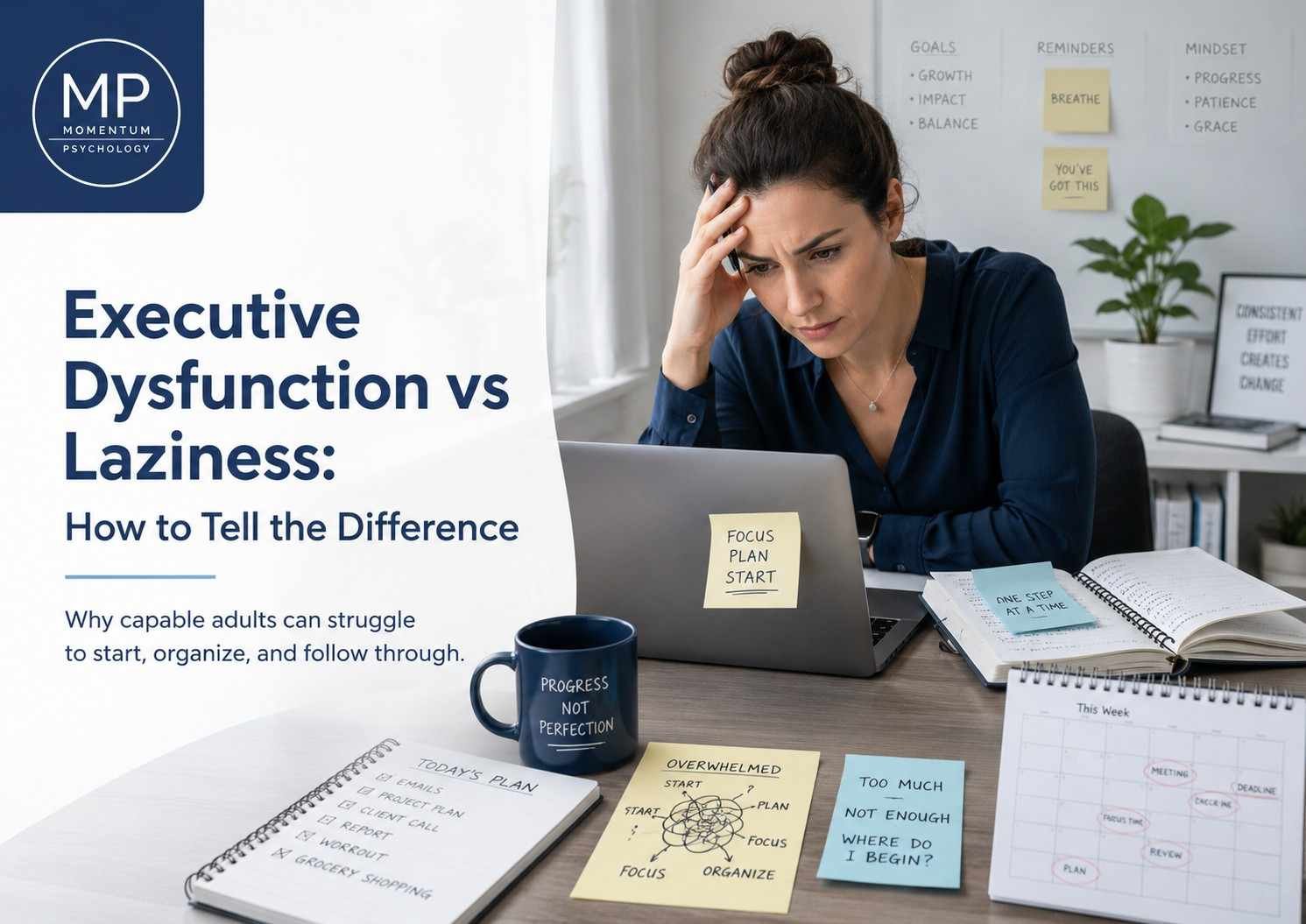
Executive dysfunction vs laziness is the wrong moral debate and the right clinical question is: what process is breaking down? Executive dysfunction means difficulty using mental skills like planning, prioritizing, task initiation, working memory, emotional regulation, and follow-through, even when a person cares and wants to act. “Laziness” is usually an unhelpful label because it does not explain why someone is stuck. Momentum Psychology provides doctoral-level online therapy for high-achieving adults dealing with ADHD-related executive function challenges, anxiety, burnout, procrastination, task paralysis, and workplace pressure.
This article is educational and not a substitute for care from a qualified mental health professional.
What Is Executive Dysfunction?
Executive dysfunction refers to difficulty using executive-function skills that help people plan, organize, initiate, prioritize, regulate effort, shift attention, remember steps, and follow through.
It is not a formal diagnosis by itself. Executive dysfunction can occur with ADHD, but it is not always caused by ADHD. It may also appear with anxiety, depression, burnout, trauma-related stress, sleep deprivation, chronic stress, substance use, medical issues, or overwhelming environments.
According to CHADD’s guide to executive function skills, executive-function areas include organizing, prioritizing and activating for tasks, focusing and shifting attention, regulating effort, using working memory, and self-regulating action.
The key issue is not that someone does not care. The issue is that the mental process required to convert intention into action is not working smoothly.
Why “Laziness” Is Usually the Wrong Explanation
“Laziness” is a judgment, not a mechanism.
It does not explain why someone wants to complete a task but cannot start. It does not explain inconsistent performance, intense shame, last-minute activation, avoidance, or panic. It also does not help someone build better systems.
A more useful question is:
“What process is breaking down?”
Is the problem task initiation? Prioritizing? Sequencing? Working memory? Emotional regulation? Time awareness? Burnout? Fear of feedback? Too many hidden decisions?
People avoid tasks for many reasons. But calling the pattern laziness often blocks the real work: identifying the barrier and changing the system.
Executive Dysfunction vs Laziness
| Pattern | Executive Dysfunction | Laziness Label |
| Desire to complete the task | The person often wants the outcome and may care deeply. | Assumes the person does not care enough. |
| Emotional response | Shame, frustration, anxiety, overwhelm, or self-criticism are common. | Frames the problem as attitude or character. |
| Starting the task | Starting may feel mentally blocked even when the task matters. | Assumes starting should be simple. |
| Follow-through | Progress may be inconsistent, especially with unclear or multi-step tasks. | Treats inconsistency as lack of discipline. |
| Time awareness | Time may feel vague, distorted, or hard to estimate. | Assumes the person is choosing to delay. |
| Shame/self-criticism | Often intense because the person knows what needs to happen. | Usually increases shame without solving the issue. |
| Response to structure | External structure, deadlines, body doubling, reminders, and smaller steps may help. | Ignores the role of systems and support. |
| Common drivers | ADHD, anxiety, burnout, depression, perfectionism, sleep disruption, stress, or overwhelm. | Usually offers no real explanation. |
The distinction matters because the solution changes. Shame does not improve executive function. Better-fit systems often do.
Common Signs of Executive Dysfunction in Adults
Executive dysfunction in adults may show up as:
- Difficulty starting tasks
- Knowing what to do but not doing it
- Losing track of steps
- Trouble prioritizing
- Underestimating or overestimating time
- Forgetting tasks unless they are externally visible
- Avoiding tasks that require planning
- Feeling overwhelmed by multi-step work
- Difficulty switching tasks
- Procrastinating until pressure creates urgency
- Starting many things but finishing few
- Trouble organizing materials, time, or ideas
- Feeling mentally blocked by simple tasks
- Inconsistent performance despite strong ability
If starting is the hardest part, Momentum’s article on ADHD task paralysis in adults may be useful. For adults who suspect ADHD-related executive function challenges, ADHD therapy for adults can help build practical systems while addressing shame, avoidance, and emotional overwhelm.
Why High-Achieving Adults Can Still Have Executive Dysfunction
High-achieving adults can have executive dysfunction and still appear successful.
They may compensate with intelligence, urgency, perfectionism, long hours, or deadline panic. Their outcomes may hide the cost of the process. They may be praised for results while privately feeling chaotic, exhausted, and inconsistent.
High achievers may:
- Use pressure as an activation system
- Perform well externally while struggling internally
- Mistake compensation for ease
- Feel ashamed because others assume they are too capable to struggle
- Rely on crisis energy to finish important work
- Become more impaired when structure decreases or workload increases
- Notice executive dysfunction more clearly after burnout develops
Momentum’s therapy for busy professionals is designed for capable adults whose internal experience may be more strained than their external performance suggests.
Executive Dysfunction, ADHD, Anxiety, Burnout, and Depression: How They Overlap
The same behavior — not starting, delaying, forgetting, or avoiding — can have different causes.
ADHD can affect attention, organization, task initiation, working memory, and self-regulation. NIMH describes ADHD as involving symptoms such as difficulty paying attention, staying on task, and staying organized in its overview of ADHD. CDC estimated that in 2023, 15.5 million U.S. adults had a current ADHD diagnosis, with about half reporting diagnosis in adulthood, according to its MMWR report on adult ADHD diagnosis and treatment.
Other patterns can also affect executive functioning:
- Anxiety can make action feel risky and increase avoidance.
- Burnout can reduce energy, flexibility, and motivation.
- Depression can reduce drive, concentration, and self-trust.
- Perfectionism can make starting feel like committing to a standard.
- Sleep deprivation can impair attention and planning.
- Trauma-related stress can keep the nervous system focused on threat rather than planning.
NIMH explains that anxiety disorders involve more than occasional worry or fear, and WHO defines burnout as an occupational phenomenon resulting from chronic workplace stress that has not been successfully managed.
If anxiety is part of the pattern, anxiety therapy may help. If burnout is driving the shutdown, stress and burnout therapy may be more relevant. For diagnostic clarity, Momentum’s resources on adult ADHD diagnosis and ADHD assessment may help.
Executive Dysfunction vs Procrastination
Procrastination means delaying. Executive dysfunction means difficulty with the mental operations needed to act.
They can overlap.
Someone may procrastinate because a task is unpleasant, boring, unclear, emotionally loaded, low reward, or hard to sequence. ADHD-related inattention symptoms have also been associated with procrastination in research, including a PMC/NIH-hosted study on procrastination and ADHD-related symptoms. That does not mean all procrastination is ADHD. It means procrastination should be understood as a pattern with possible causes, not dismissed as a character flaw.
The Loop: Stuck, Shame, Pressure, Last-Minute Action
Executive dysfunction often becomes harder because of the shame loop:
- A task requires planning, sequencing, or initiation.
- The person gets stuck.
- Shame and self-criticism increase.
- Avoidance continues.
- Pressure rises.
- Panic or urgency finally activates action.
- The task gets done, but exhaustion increases.
- The brain learns that crisis is the way to start.
This loop can produce strong results and still be harmful. The work gets done, but the person pays with stress, sleep loss, resentment, and reduced self-trust.
If every choice feels heavy, Momentum’s article on decision fatigue at work may be relevant. If stress is keeping the system activated, the guide on how to manage stress effectively can offer additional support.
How to Tell What Might Be Happening
This section is not a diagnosis. It is a way to gather better information.
Look at Desire: Do You Want the Outcome?
If you genuinely care about the result but still cannot act, laziness is probably not the best explanation. The problem may be initiation, fear, energy, clarity, or structure.
Look at Friction: Where Exactly Does the Process Break?
Does the breakdown happen when you start, prioritize, estimate time, remember the task, switch tasks, tolerate uncertainty, or complete the final step?
The more specific you are, the more useful the solution becomes.
Look at Pattern: Does This Happen Across Settings?
Executive dysfunction often appears across multiple settings, though not always equally. You may do well with urgency, novelty, interest, or external structure, and struggle when tasks are vague, boring, repetitive, or self-directed.
Look at Structure: Do External Deadlines or Body Doubling Help?
If external structure helps dramatically, the issue may be less about motivation and more about activation, attention, or accountability scaffolding.
Look at Emotion: Is Shame, Fear, or Perfectionism Involved?
A task may look simple on paper but feel emotionally loaded. Fear of failure, rejection, criticism, or imperfection can increase avoidance.
Look at Energy: Is Burnout or Sleep Debt Present?
Sometimes executive dysfunction becomes worse because the system is depleted. A tired brain has less capacity for planning, inhibition, and flexible problem-solving.
Look at History: Has This Been Lifelong or Recent?
A lifelong pattern may point toward ADHD or longstanding executive-function challenges. A recent change may suggest burnout, depression, anxiety, grief, trauma-related stress, medical issues, sleep problems, or a major life transition.
What to Do When It Feels Like Executive Dysfunction
Stop Arguing With the Laziness Label
The label wastes energy. Replace “I’m lazy” with “Something in the process is breaking down.”
That shift matters because it moves you from shame to problem-solving.
Name the Broken Step
Ask:
- Is this a starting problem?
- A prioritizing problem?
- A sequencing problem?
- A remembering problem?
- A switching problem?
- An emotional regulation problem?
- A perfectionism problem?
One broken step is easier to support than a global identity judgment.
Make the Task Visible
Executive function often improves when the task is externalized.
Use:
- sticky notes
- whiteboards
- checklists
- calendar blocks
- timers
- visual task boards
- written next steps
Do not keep everything in your head.
Reduce the First Action
The first action should be visible and small.
Instead of “finish the proposal,” try “open the proposal document and write three rough bullets.”
Remove Hidden Decisions
Many tasks contain invisible decisions about format, order, timing, standard, tone, priority, and first step.
Remove as many as possible before starting.
Use External Structure
External structure may include body doubling, coworking, accountability check-ins, scheduled focus blocks, reminders, or collaborative planning.
Structure is not weakness. It is design.
Build Routines That Reduce Starting Friction
Routines lower the number of decisions required to begin.
Example:
- Open calendar.
- Choose one task.
- Set a 10-minute timer.
- Open the relevant file.
- Write one rough sentence.
- Record the next step before stopping.
Use Values Instead of Mood as the Filter
Mood is unreliable. Values are steadier.
Momentum’s Acceptance and Commitment Therapy work often focuses on values-based action under discomfort. Momentum’s values exercises can help when motivation is low, and defusion exercises can help when self-critical thoughts are loud.
Practice Self-Compassion After Delayed Starts
Shame makes executive dysfunction worse. Momentum’s self-compassion exercises can help reduce harsh self-judgment after delayed starts.
Get Support When the Pattern Is Persistent
Support may include therapy, ADHD assessment, medical consultation, coaching, workplace accommodations, or changes to workload and environment.
A Practical Reset Plan for Executive Dysfunction
| Moment | What the Laziness Label Says | More Useful Interpretation | Better Next Step |
| You cannot start a task | “I’m lazy.” | The first step may be unclear or too large. | Define one visible action. |
| You miss a deadline | “I’m irresponsible.” | Time estimation or sequencing may have failed. | Break the next deadline into checkpoints. |
| You avoid email | “I’m avoiding work.” | Email may trigger threat, shame, or overwhelm. | Use a 15-minute inbox window. |
| You feel overwhelmed by choices | “I should just decide.” | Prioritizing may be overloaded. | Narrow to two options. |
| You wait for pressure to act | “I only work in panic.” | Urgency may be your activation system. | Add external structure earlier. |
| You forget a task | “I don’t care.” | Working memory may need external support. | Put the task somewhere visible. |
| You freeze after feedback | “I’m too sensitive.” | Feedback may trigger threat or shame. | Separate task feedback from identity. |
| You feel ashamed after delaying | “I failed again.” | Shame is increasing friction. | Repair with one next action. |
For related patterns, see Momentum’s articles on email anxiety and rejection sensitivity at work.
A 10-Minute Executive Function Reset
Use this when you feel stuck.
- Write the task in one sentence.
- Identify which executive function is failing: starting, prioritizing, sequencing, remembering, shifting, or regulating emotion.
- Choose one visible first action.
- Remove every nonessential decision.
- Set a 10-minute timer.
- Start imperfectly.
- Write the next step before stopping.
- Reward the process, not only completion.
The goal is not to finish everything. The goal is to create movement.
When Executive Dysfunction May Be a Sign to Seek Therapy
Therapy may help when executive dysfunction affects work, school, relationships, daily life, or self-trust.
Consider support if:
- Shame or self-criticism is intense
- You rely on panic or deadlines to function
- You avoid tasks until consequences become serious
- ADHD may be undiagnosed
- Anxiety, burnout, perfectionism, depression, or trauma-related stress may be involved
- You feel capable but cannot build consistent systems
- Executive function challenges are affecting your confidence or relationships
For high-achieving adults, online therapy can make support easier to access around demanding schedules. Executive dysfunction can also overlap with over-responsibility at work and workplace hypervigilance when pressure, vigilance, and responsibility overload make action harder.
How Therapy Can Help With Executive Dysfunction
Therapy does not guarantee productivity or cure ADHD. But it can help identify what is actually breaking down and build better-fit systems.
Therapy may help you:
- Reduce shame and self-criticism
- Build executive-function supports
- Address ADHD-related task initiation if relevant
- Improve planning, prioritizing, and follow-through
- Address anxiety, perfectionism, or avoidance
- Support burnout recovery and boundaries
- Build tolerance for imperfect starts
- Reconnect action with values instead of fear
ADHD-focused therapy may support practical executive-function systems. CBT may help identify all-or-nothing thinking and avoidance patterns. ACT may help build values-based action under discomfort. DBT-informed skills may support emotion regulation. Self-compassion work may reduce harsh self-judgment. Coaching-style structure may support planning and follow-through. Trauma-informed therapy may help when difficulty acting is tied to threat responses.
If the issue feels like low drive, Momentum’s article on how to regain motivation at work may also help clarify the difference between low motivation, burnout, avoidance, and executive-function strain.
Final Thoughts: The Right Question Is Not “Am I Lazy?”
Executive dysfunction vs laziness is the wrong moral debate.
The better question is:
“What process is breaking down?”
Adults who struggle to start, organize, prioritize, or follow through may need structure, support, treatment, self-compassion, and better-fit systems — not shame.
Momentum Psychology provides doctoral-level online therapy for high-achieving adults and professionals navigating ADHD-related executive function challenges, anxiety, stress, burnout, perfectionism, procrastination, avoidance, and workplace pressure. If executive dysfunction vs laziness has become a painful question in your life, you can start therapy.
FAQs About Executive Dysfunction vs Laziness
What is the difference between executive dysfunction and laziness?
- Executive dysfunction is difficulty using mental skills such as planning, starting, organizing, prioritizing, remembering, shifting attention, or following through. Laziness is a moral label and usually does not explain what is happening. If someone wants to act but feels stuck, executive dysfunction may be a better framework to explore.
Is executive dysfunction always ADHD?
- No. Executive dysfunction can occur with ADHD, but it is not always caused by ADHD. Anxiety, depression, burnout, trauma-related stress, sleep deprivation, medical issues, substance use, and overwhelming environments can also affect executive functioning. A qualified professional can help clarify what may be involved.
Why do I want to do things but still cannot start?
- You may want the outcome but struggle with task initiation, prioritizing, emotional regulation, uncertainty, perfectionism, or working memory. Starting requires several executive functions before visible work begins. When those systems are overloaded, intention may not automatically turn into action.
Is procrastination a sign of executive dysfunction?
- Procrastination can be related to executive dysfunction, but they are not identical. Procrastination means delaying. Executive dysfunction involves difficulty with the mental operations needed to act. ADHD, anxiety, perfectionism, burnout, or unclear tasks can all contribute to procrastination-like patterns.
Can anxiety or burnout cause executive dysfunction?
- Anxiety and burnout can contribute to executive-function problems. Anxiety may make tasks feel risky or overwhelming, while burnout can reduce energy, flexibility, and motivation. When stress is chronic, planning, attention, decision-making, and follow-through may become harder.
How do I stop calling myself lazy?
- Start by replacing the label with a better question: “What process is breaking down?” Identify whether the issue is starting, prioritizing, sequencing, remembering, shifting, or emotional regulation. This shift reduces shame and makes it easier to build systems that actually help.
Can therapy help with executive dysfunction?
- Therapy may help by identifying what is breaking down, reducing shame, building practical executive-function supports, addressing anxiety or perfectionism, and improving planning, prioritizing, and follow-through. Therapy does not guarantee productivity, but it can help create more workable systems.
When should I seek help for executive dysfunction?
- Consider seeking help when executive dysfunction affects work, school, relationships, daily responsibilities, or self-trust. Support may be especially useful if you rely on panic to function, avoid tasks until consequences become serious, suspect ADHD, or feel intense shame about delayed starts.