
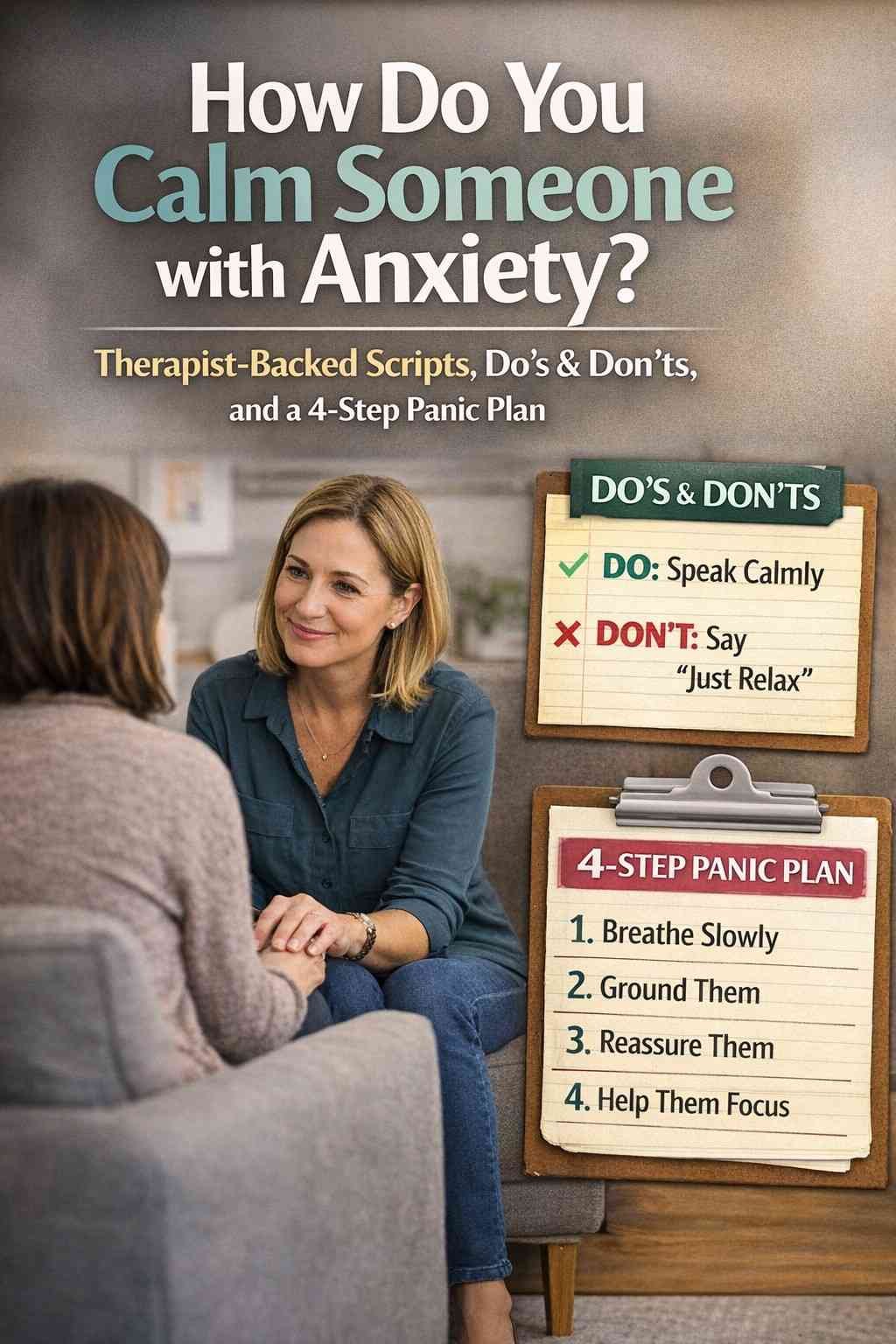
The most helpful way to calm someone with anxiety is to keep your own tone steady, validate what they’re feeling, ask what kind of help they want, and avoid minimizing or pressuring. In a panic moment: move to a quieter space if possible, guide slow breathing, try a simple grounding exercise, and stay with them; seek medical help if symptoms don’t settle or safety is a concern.
Read more: Is it Time to Consult an Anxiety Therapist? Signs You Shouldn’t Ignore
Anxiety in plain language (why people feel “stuck on high”)
Anxiety shows up as a cluster of thoughts (worry, “what if?”), body signals (racing heart, short breath), and behaviors (avoidance, reassurance-seeking). Everyday anxiety is part of being human; a disorder is when the fear is persistent and begins to disrupt school, work, sleep, or relationships. Effective care includes talking therapies such as CBT and, when appropriate, medication—decisions best made with a clinician.
Why this matters for supporters: once you recognize the pattern—threat → alarm → avoid/reassure → short relief → stronger anxiety next time—you can respond to the process (lower arousal, reduce avoidance, replace endless reassurance with steady support) rather than trying to “fix their feelings” in the moment. Mind’s guidance for friends and family emphasizes practical help (appointments, company, planning) over pep talks.
Read more: How to Help Someone with Anxiety: 5 Compassionate Techniques
What to say (and not say): 10 ready-to-use scripts
Use these verbatim or adapt to your voice. The goal is validation, choice, and calm structure.
- Validate + relocate (if overstimulated):
“It makes sense you’re stressed—want to sit somewhere quieter for a minute?” (Validation lowers arousal; a calmer setting helps the body settle.) - Ask needs clearly (give control):
“What would help most right now—listening, problem-solving, or a distraction?” (Matching support to preference matters.) - Breathing cue (simple and paced):
“Let’s breathe slowly together—in through your nose, out through your mouth.” (Slow, paced breathing helps counter panic hyperventilation.) - Keep language short and predictable:
“I’m here. We’ll do this one step at a time.” (Short phrases prevent cognitive overload.) - Ground attention (5-4-3-2-1):
“Tell me 5 things you see… 4 you can touch… 3 you can hear… 2 you can smell… 1 you can taste it.” (A widely used sensory grounding technique.) - Practical help (appointments/logistics):
“Want me to sit with you while you call the clinic? We can jot a few questions first.” (Reduce friction to care.) - Reassurance limits (kind boundary):
“I care about you. Instead of me answering the same worry again, let’s write it down and check it together tomorrow.” (Prevents reassurance cycles.) - After a wobble (reinforce learning):
“That was hard—and you stayed with it. What helped? What would you try first next time?” (Shifts from rumination to reflection.) - Normalize professional help:
“This has been heavy. Would you be open to talking with a GP or therapist? I can help find options and go with you.” (Early, supported help improves outcomes.) - Boundaries + care (protect the helper):
“I’m free to talk until 8:30 and can check in tomorrow at 7. Does that work?” (You help best when you’re not depleted.)
Read more: Managing Anxiety: Therapeutic Techniques for Success
Do’s and Don’ts (evidence-guided)
| Do | Why it helps | Don’t | Why it backfires |
| Validate and listen; keep a calm tone | Lowers arousal and stigma | “Just calm down/it’s in your head” | Minimizes; can escalate distress |
| Ask what helps; follow their preference | Restores control, builds trust | Force advice or exposure | Feels unsafe; harms trust |
| Offer practical support (appointments, notes) | Reduces overwhelm | Take over everything | Can enable avoidance |
| Encourage professional help when life is impacted | Connects to evidence-based care | Treat peer groups as a replacement for care | Support groups ≠ therapy |
| Support basics (sleep routine, morning light, limit caffeine) | Routines reduce symptom load | Endless reassurance loops | Maintains anxiety mechanisms |
(Adapted from NHS, NIMH, Mind, and Hopkins guidance.)
Read more: Navigating Entrepreneurial Anxiety: Therapy Solutions
The 4-Step Panic Plan (for laypeople)
Short answer: Ask permission to help, keep language short, guide slow breathing, ground attention with a simple exercise, and escalate to medical help if symptoms don’t ease or safety’s a concern.
- Permission + presence
Begin with consent and proximity: “I’m here. Want help focusing on your breath?” Stand or sit nearby, speak slowly, and avoid sudden movements. - Slow breathing (paced, not forced)
Coach in through the nose, out through the mouth, at a pace you can both maintain. Deep, paced breathing reduces hyperventilation and calms the autonomic response. - Grounding (5-4-3-2-1 or 3-3-3)
Shift attention to the present: notice sensations, sounds, and sights in the room. The 5-4-3-2-1 method is simple and portable. - Escalate when appropriate
If symptoms don’t settle, if the person wants medical help, or if you’re worried about their safety, seek clinical input and follow local services in your region.
Read more: Cultivating Success: Anxiety Therapy for High Achievers
When to suggest professional help (and how to make it easier)
If anxiety lasts weeks, interferes with school/work/sleep/relationships, or panic is frequent, it’s time to guide toward a GP or licensed therapist. Offer to help research options, prepare questions, and attend the first appointment (even just waiting outside). Point them to reputable overviews (NIMH) so they’re not relying on random forums.
Checklist you can do together:
- Write 3–5 concerns or situations that feel hardest.
- List current coping attempts (what’s helping, what isn’t).
- Bring a brief health/medication history.
- Decide what support you’ll give after the appointment (rides, reminders, quiet company).
Read more: Balancing Brilliance: Anxiety Therapy for High Achievers
Support vs. enabling: finding the line
Comfort is caring; avoidance isn’t. Doing every hard task for someone or giving endless reassurance can accidentally cement anxiety’s rules (“I can’t handle this without you”). Better: agree on tiny next steps and cheer effort, not perfection. Hopkins highlights that repetitive reassurance and over-accommodation may keep anxiety loops spinning; gently replace them with skills and graduated challenges.
Quick self-check for supporters:
“Does what I’m doing move them toward what matters—or away from it?”
If it’s the latter, adjust: “I’ll walk with you to the entrance; you’ll take the first two minutes. Then I’ll meet you in the lobby.”
Read more: Academic Anxiety and The Importance of Therapy for Students
Seven micro-habits that really help (for friends & family)
- Name + warmth: Use their name and a steady tone: “I’m here, Amina. One step at a time.” (Personalization reduces threat.)
- Choices, not commands: Offer two simple options (sit/step outside; water/quiet). Choice restores agency.
- Co-regulate with breathing: Count a slow 4-in, 4-out together—no performance pressure.
- Grounding on the go: Practice 5-4-3-2-1 in calm moments so it’s ready when needed.
- Model routine basics: Encourage a consistent sleep routine, morning light, and sensible caffeine—small levers, big payoff alongside therapy.
- Track what helps: Keep a tiny “what calms me” list on your phones (phrases, places, people). Mind’s guidance stresses planning and practical support.
- Protect your bandwidth: Set availability windows and involve other supporters so help is sustainable.
Read more: Therapy for Entrepreneurs: Addressing Anxiety and Stress
Common mistakes to avoid (and what to do instead)
- Minimizing (“Just calm down”) → Try: “This is hard—and I’m here. Want listening, ideas, or a short distraction?”
- Talking fast / overexplaining → Try: short, predictable sentences; fewer words, steadier tone.
- Repeating reassurance on loop → Try: write it down, agree to revisit once; redirect to a skill (breath/ground/exposure step).
- Avoiding everything “just in case” → Try: graded approach: tiny step today, repeat tomorrow, add difficulty later. (This gradually disconfirms fears.)
Read more: Anxiety Therapy: Techniques for Daily Life
FAQs
What’s the kindest first response?
- Listen without judgment, validate the feeling, and ask what support would help most—listening, problem-solving, or a brief distraction.
Is breathing actually helpful?
- Yes. Slow, paced breathing can reduce hyperventilation and help symptoms pass during panic. Keep it gentle and steady.
What grounding works best?
- A simple sensory scan like 5-4-3-2-1 (five things you see… one you taste) is portable and easy to coach anywhere.
When should I suggest therapy?
- If anxiety persists for weeks or disrupts school, work, sleep, or relationships, encourage a GP/therapist and offer help with logistics.
Momentum Psychology: turn good intentions into a calm, clear plan
Why Momentum Psychology
• Doctoral-level clinicians (CBT/ACT/ERP) who teach brief, compassionate scripts for real life
• Mechanism-first plans: reduce reassurance cycles, build approach behaviors, and practice breathing/grounding together
• Progress you can see: simple weekly dashboards so everyone knows what’s working
• Online across PSYPACT states (where permitted)
Want a one-page support plan for your situation? Book a brief consult and leave with the exact scripts, boundaries, and next steps you can use tonight.