
EMDR (Eye Movement Desensitization and Reprocessing) is a structured psychotherapy best known for trauma treatment. For anxiety, EMDR tends to be most useful when your anxiety is being driven by distressing memories, “stuck” fear learning, or body-level threat responses that don’t respond well to logic alone. Evidence from randomized trials suggests EMDR can reduce anxiety, panic, and phobia symptoms, though research still calls for clearer long-term and diagnosis-specific findings.
This guide breaks down:
- when EMDR is a strong fit for an
- anxiety (and when CBT is usually a better first move),
- what happens in the 8 phases,
- therapist-style skills + scripts you can use safely (without DIY reprocessing),
Read more: Is it Time to Consult an Anxiety Therapist? Signs You Shouldn’t Ignore
Can EMDR help anxiety?
- Yes—especially for panic and phobia-type anxiety, and for anxiety linked to distressing memories. A meta-analysis of randomized controlled trials found EMDR reduced symptoms of anxiety, panic, phobia, and related somatic/behavioral symptoms, while also noting more research is needed on long-term effects.
When EMDR is usually not the best first step:
- If your anxiety is primarily future-worry and overthinking without a clear memory/trigger network driving it, CBT (and exposure-based CBT) is often the more direct first-line path.
Read more: How to Help Someone with Anxiety: 5 Compassionate Techniques
What EMDR is
EMDR is a structured, eight-phase therapy that combines focused attention on a distressing memory (or trigger) with bilateral stimulation (often guided eye movements, but sometimes tapping or tones). The goal is to reduce how intensely the memory “hits” and help the brain integrate more adaptive beliefs and body responses.
Two things competitors often gloss over:
- EMDR isn’t one technique. It’s a protocol with phases that prioritize safety, preparation, and reevaluation—not just “do eye movements and feel better.”
- Preparation matters. If you skip stabilization, you can feel flooded—especially if you have complex trauma, dissociation, or chronic hypervigilance.
Read more: Managing Anxiety: Therapeutic Techniques for Success
Evidence snapshot (high-authority, no hype)
- A 2020 meta-analysis of randomized controlled trials concluded EMDR reduced symptoms of anxiety, panic, and phobia, and called for more research on long-term efficacy.
- A clinical review of RCTs summarized that EMDR showed positive effects across multiple trials for panic and phobic symptoms, with mixed results in some studies and the overall label of “preliminary” for anxiety-disorder breadth.
- Global guidelines strongly support EMDR for stress-related conditions like PTSD, which matters because many anxiety presentations are trauma-linked (not because all anxiety is PTSD).
Translation: EMDR can be a strong option for anxiety when the anxiety is memory-linked or fear-conditioning-driven, and it should be delivered with proper preparation and pacing.
Read more: Navigating Entrepreneurial Anxiety: Therapy Solutions
The “fit test”: when EMDR is a smart choice for anxiety
Use this like a decision filter (it will also differentiate your post from competitors).
Green lights (EMDR tends to fit well)
- Panic attacks that “feel like they come from nowhere,” but actually link to bodily alarm cues or earlier frightening experiences
- Specific fears/phobias that behave like fear conditioning (your nervous system reacts before your logic catches up)
- Anxiety that spikes with sensory triggers (places, smells, tones, touch, conflict cues)
- “I know I’m safe, but my body doesn’t believe it”
Yellow lights (EMDR can work, but prep is non-negotiable)
- Complex trauma, chronic emotional neglect, attachment wounds
- Dissociation or “numbing / spacing out” under stress
- Active life instability (sleep deprivation, substance misuse, ongoing unsafe relationships)
Red lights (don’t push EMDR processing first)
- Active crisis, current unsafe environment, or severe instability where stabilization must come first
- When your clinician flags high dissociation risk and recommends longer prep and skills-first work
Read more: Cultivating Success: Anxiety Therapy for High Achievers
What happens in EMDR (the 8 phases)
You’ll see this list everywhere, but most competitor articles don’t explain what the phases do for anxiety. Here’s the therapist-logic version.
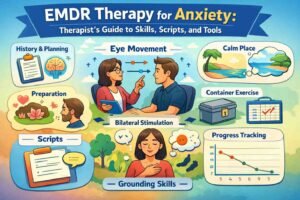
EMDR follows eight phases: History, Preparation, Assessment, Desensitization, Installation, Body Scan, Closure, Reevaluation.
Phase 1 — History & treatment plan
You and your therapist map symptoms, triggers, and likely target memories. For anxiety, targets may include panic onset memories, humiliations, medical scares, accidents, conflict episodes, or repeated “small t” moments that trained the nervous system.
Phase 2 — Preparation (the most skipped, most important)
You learn stabilization skills and resourcing so you can stay in your “window of tolerance.” EMDRIA emphasizes that preparation is part of the framework—not optional.
Phase 3 — Assessment
You identify:
- the target memory image,
- a negative cognition (“I’m not safe,” “I’m powerless”),
- a preferred positive cognition (“I can handle this”),
- and your starting distress level.
Phase 4 — Desensitization
This is the “processing” stage. Distress typically decreases over sets as the memory network changes.
Phase 5 — Installation
The positive cognition is strengthened (not as forced affirmations—more like “this now feels true”).
Phase 6 — Body scan
You check whether any residual tension, nausea, tightness, or chest pressure remains tied to the target. If yes, that becomes part of the processing focus.
Phase 7 — Closure
You re-stabilize and leave the session grounded—even if processing isn’t “finished.”
Phase 8 — Reevaluation
The next session starts by checking what changed, what surfaced, and what to target next. This is how EMDR becomes a structured course of treatment rather than a one-off technique.
Read more: Balancing Brilliance: Anxiety Therapy for High Achievers
Safety boundary: what you can do yourself vs what you shouldn’t
Competitors often blur this line. Don’t.
Safe self-use (supportive skills)
You can safely practice: grounding, containment, calming imagery, paced breathing, journaling boundaries, and “after-session” care.
Not recommended to DIY
Do not attempt self-directed memory processing protocols. A review of self-administered EMDR found only one small primary study and noted substantial methodological issues—even when no serious adverse events were reported.
Positioning line you should include (high trust):
“Self-regulation skills are DIY-friendly. EMDR reprocessing is clinician-led for a reason.”
Read more: Academic Anxiety and The Importance of Therapy for Students
Therapist-style skills, scripts, and tools (client-safe, not DIY reprocessing)
Below are Phase-2-friendly scripts and tools you can publish safely. They’re designed to reduce anxiety and improve readiness for therapy.
1) The “90-second nervous system reset” script
Use when anxiety spikes fast.
Script:
“Name what’s happening: ‘My alarm system is on.’
Feet on the ground. Exhale longer than inhale for 6 breaths.
Now locate 3 neutral sensations (pressure of chair, air on skin, weight of hands).
Tell your body: ‘Right now, in this moment, I am safe enough.’”
Why it works: it shifts attention from prediction loops to sensory present, reduces spiraling, and builds self-efficacy.
2) Containment (“Container”) tool — for intrusive anxiety and rumination
Containment is widely taught in EMDR preparation as a stability tool.
Script:
“Imagine a container that can hold distress safely—sealed, strong, and under your control.
Label what you’re putting in (images, worries, body sensations) without re-entering the story.
Place it in the container. Lock it.
Tell yourself: ‘I can return to this with support at a planned time.’”
A clinical Q&A describes the container resource as a preparation-phase tool that supports stability and affects tolerance.
3) “Safe place / calm place” installation (pre-session tool)
Script:
“Picture a place that feels steady—real or imagined.
Add sensory detail: light, temperature, sounds, textures.
Name the feeling you want most there: calm, safety, steadiness, warmth.
Take 3 slow breaths and let your shoulders soften.”
Important: This is not processing. It’s stabilization.
4) The “panic reframe” script (for fear of fear)
Script:
“Panic is uncomfortable, not dangerous.
My body is firing a false alarm.
I don’t need to win against it. I need to ride it down.”
This is a CBT-compatible script that also supports EMDR readiness by reducing secondary fear.
5) The “therapist check-in” script (what to say in session)
Many clients don’t know how to ask for pacing.
Script to bring to therapy:
“I want to go slower. I’m getting flooded.
Can we pause and use grounding?
I want to stay within tolerance.”
This script is simple, and it prevents push-through retraumatization.
6) After-session “closure routine” (10 minutes)
Plan:
- Hydrate + light protein
- Short walk or shower
- No deep journaling of trauma content
- Note 3 data points only: (what shifted, what felt hard, what helped)
- Early bedtime if possible
Health rsources note EMDR can temporarily intensify distress symptoms for some people; your closure routine is how you reduce “carryover.”
Read more: Therapy for Entrepreneurs: Addressing Anxiety and Stress
Progress-tracking table (simple, therapist-grade)
EMDR commonly uses SUD (Subjective Units of Disturbance) and VOC (Validity of Cognition) scales in-session to track change.
Use this weekly tracker to show momentum (great for readers + conversions):
| Week | Main trigger (1–2) | Peak anxiety (0–10) | Avoidance (0–10) | Body symptom (top 1) | Skill used most | What improved (1 line) | Next micro-goal |
| 1 | |||||||
| 2 | |||||||
| 3 | |||||||
| 4 |
How to interpret (AEO block):
- If peak anxiety drops but avoidance stays high → target avoidance ladder + exposure planning.
- If avoidance drops but body symptoms persist → strengthen body-based resourcing and pacing.
- If symptoms spike after sessions → increase preparation time and closure rituals. EMDR is structured to allow returning to preparation whenever needed.
Read more: Anxiety Therapy: Techniques for Daily Life
EMDR vs CBT for anxiety (the honest comparison)
CBT is often the best first approach when anxiety is mainly driven by worry, predictions, and cognitive distortions. EMDR is often a strong add-on or alternative when anxiety is driven by memory networks, fear conditioning, or body-alarm loops that don’t shift through insight alone.
Best practice framing: many people do best with a blended plan—CBT skills for daily functioning plus EMDR for deeper “stuck” drivers.
How to promote Momentum Psychology with this post (without sounding salesy)
Your promotion should feel like clinical stewardship, not marketing.
1) Internal link map (recommended anchors)
Add 3–5 internal links:
- “Anxiety therapy” → your anxiety service page
- “Trauma therapy” → your trauma page/post (if you have one)
- “Online therapy” / “teletherapy” page (if applicable)
- 1 related blog post: panic, grounding skills, perfectionism/high achiever anxiety, etc.
2) Conversion block that doesn’t feel pushy (paste this near the end)
“If you’re considering EMDR for anxiety, the most important variable is pacing and preparation. A good therapist will assess fit, teach stabilization skills first, and only move into processing when you can stay grounded. If you want help building a plan like that, Momentum Psychology’s anxiety therapy team can help you get started.”
3) Repurpose for distribution (high ROI)
- Short video: “Green/Yellow/Red fit test for EMDR and anxiety”
- Carousel: “8 EMDR phases in one sentence each”
- Lead magnet: “EMDR readiness checklist + weekly tracker”
- Email: “EMDR for anxiety: what it helps, what it doesn’t”
FAQs
Can EMDR help anxiety if I don’t have ‘big trauma’?
- Yes. EMDR may help when anxiety is tied to distressing memories or fear of learning—even if you don’t label it “big trauma.” Evidence suggests benefits across anxiety/panic/phobia symptoms, though results vary by condition and more long-term research is needed.
Is EMDR good for panic attacks?
- Research summaries of RCTs show positive effects in panic and phobic symptoms in multiple trials, with some mixed findings across studies.
Is EMDR good for generalized anxiety disorder (GAD)?
- Evidence exists but is less definitive than for panic/phobic presentations. Some preliminary studies report reductions in pathological worry, but the overall anxiety literature still calls for stronger and longer follow-up trials.
Can EMDR make anxiety worse at first?
- It can temporarily increase distress for some people, especially early on or when processing intense material. That’s why preparation, pacing, and closure routines matter.
What are the 8 phases of EMDR?
- History, Preparation, Assessment, Desensitization, Installation, Body Scan, Closure, Reevaluation.
What is bilateral stimulation?
- It’s alternating left-right stimulation (often eye movements, tapping, or tones) used during EMDR while focusing on a target memory or trigger.
Do I have to describe everything in detail for EMDR to work?
- Many EMDR explanations note you don’t always need to share extensive detail aloud; the process focuses on internal processing while guided by the therapist.
How many EMDR sessions for anxiety?
- It depends on complexity, stability, and the number of target networks. Many clinicians emphasize that early sessions may be more preparation-heavy, with processing occurring across multiple sessions.
Can I do EMDR on myself?
- Self-administered EMDR has limited evidence; a review found only one small primary study and noted substantial methodological issues. DIY processing isn’t recommended—stick to stabilization skills and work with a trained clinician for reprocessing.
What if I dissociate or go numb during therapy?
- That’s a pacing signal. A skilled therapist will slow down, reinforce stabilization, and adjust the plan rather than pushing through processing.
Is EMDR only for PTSD?
- No, it’s most established for trauma-related conditions, but it’s also used clinically for other distressing symptoms; evidence strength varies by diagnosis.
How do I choose an EMDR therapist?
- Look for training/credentialing, a strong preparation phase, clear pacing rules, and a plan for integration/closure and reevaluation each session.