
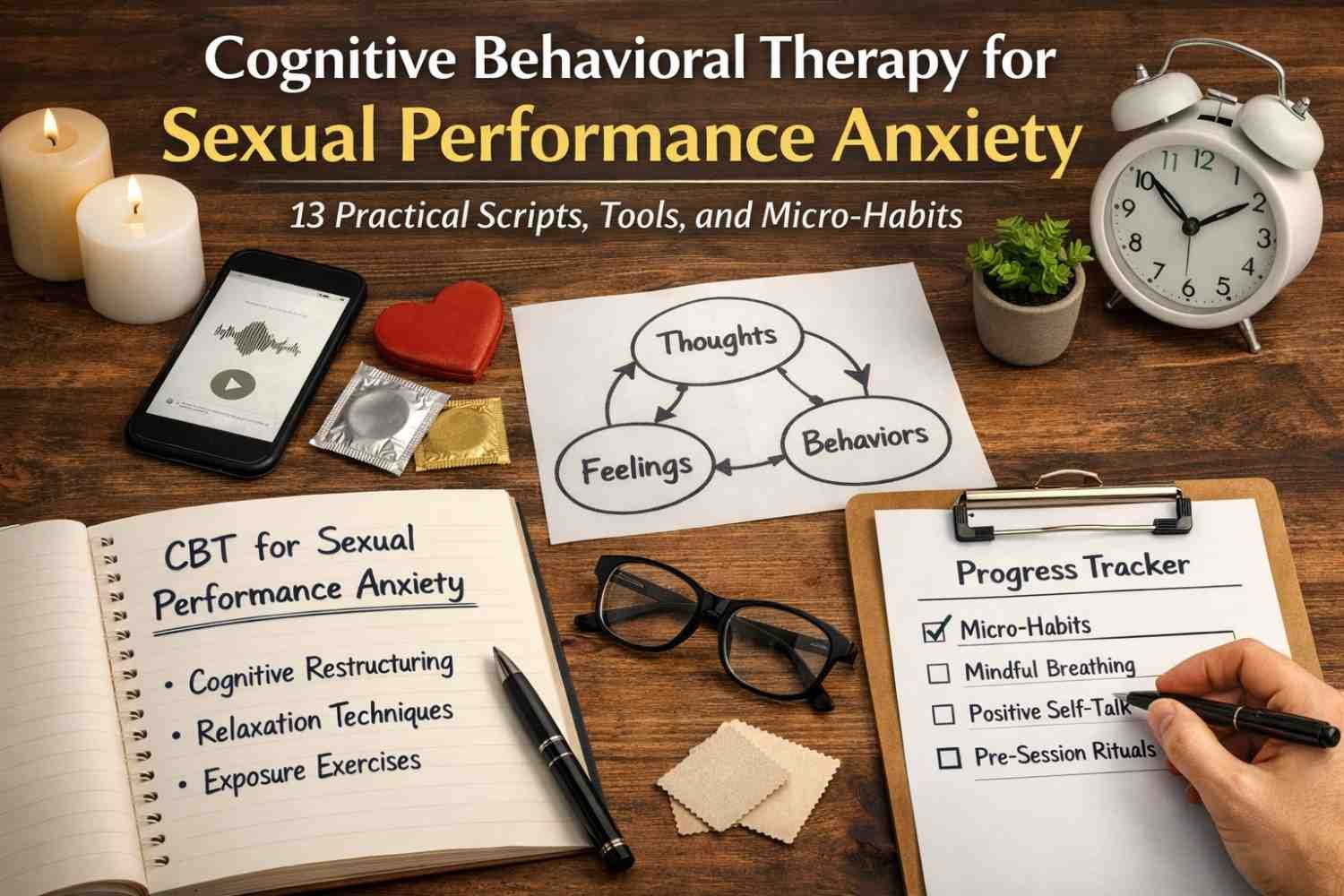
Sexual performance anxiety (SPA) is a fear-driven loop where catastrophic thoughts (“What if I fail?”) and safety behaviors (rushing, avoiding, over-monitoring—“spectatoring”) derail arousal. CBT breaks the loop with graded exposure, sensate-focus tasks, reframing scripts, and micro-habits, while ruling out medical contributors (ED/PE, meds, hormones). Prevalence estimates: ~9–25% of men; ~6–16% of women.
What SPA is—and isn’t
SPA isn’t a DSM diagnosis; think of it as a mechanism that often co-travels with erectile dysfunction (ED), premature ejaculation (PE), or low desire/arousal problems. The evidence base is strongest in adjacent conditions (ED/PE, SIAD), where CBT/behavioral therapy and mindfulness-based approaches reduce anxiety and improve sexual functioning; specific SPA RCTs are fewer, but expert reviews recommend the same toolbox.
Two nuances worth knowing:
- Anxiety isn’t always inhibitory. Lab work shows anxiety can inhibit, not change, or even facilitate arousal—so “just relax” is bad coaching. We need skills that redirect attention and reshape contingencies.
- “Spectatoring” (monitoring your own performance from the outside) is a classic CBT target. It diverts attention from sensation/connection to fear-checking.
Read more: Is it Time to Consult an Anxiety Therapist? Signs You Shouldn’t Ignore
Rule-outs first: quick medical & medication checklist (30 seconds)
Before (or alongside) CBT, screen for contributors:
- Cardiometabolic risks (BP, lipids), diabetes, hormonal issues; medication/substance effects (e.g., SSRIs for some people, alcohol, etc.).
- Pattern clues: “situational” vs “global,” morning/nocturnal erections, and whether problems happen solo vs partnered.
- Combine psychological and medical care when indicated (e.g., PDE-5 inhibitors for ED; SSRI options for PE). Guidance from national and international bodies supports this coordinated pathway.
Authoritative lay overviews: Cleveland Clinic explains SPA and when to see a professional; the UK’s NHS pages flag psychological contributors to ED and when counseling/CBT is appropriate.
Read more: How to Help Someone with Anxiety: 5 Compassionate Techniques
How CBT targets SPA mechanics (the map)
Cognitive: catch performance predictions (“I must stay hard the whole time,” “I have to orgasm quickly/slowly”), challenge them, and shift to values-based intentions (comfort, curiosity, connection).
Behavioral: replace avoidance/safety behaviors with graded exposure (stepwise intimacy), sensate focus (non-demand touch), and skills like start–stop for PE. Clinical guidelines and sexual-medicine societies endorse this mix.
CBT Target Matrix (quick reference)
| CBT target | SPA mechanism | Example practice |
| Catastrophic prediction | Threat appraisals spike arousal pressure | 3-column thought record; “data, not verdict” reframes |
| Spectatoring | Attention shifts to self-monitoring | Sensation labeling, breath + body focus |
| Avoidance & rushing | Anxiety is negatively reinforced | Graded intimacy ladder; slow-pacing scripts |
| PE urge-build | Arousal overshoots threshold | Start–stop with pause & resume parameters |
| Relationship threat cues | Pressure & misinterpretation | Partner scripts; consent + pacing ritual |
(Details and citations in sections below.)
Read more: Managing Anxiety: Therapeutic Techniques for Success
13 practical scripts, tools, and micro-habits (therapist-backed)
You don’t need all 13 at once. Pick one script, one tool, and one micro-habit to practice this week; layer others slowly.
A) Five partner & self-talk scripts (use verbatim)
- Expectation reset — “Let’s focus on comfort and connection tonight—not goals or timelines.” (Reduces demand; shifts to process.)
- Anti-spectatoring cue — “If I start monitoring, I’ll bring attention back to breath and sensation.” (Defuses self-surveillance.)
- Consent & pacing — “Slow is good. If anything feels pressured, we pause.” (Safety lowers anxiety; helps both partners.)
- Normalize a blip — “Bodies vary—this is data, not a verdict. We’ll practice again.” (Prevents global catastrophic beliefs.)
- Team-of-two plan — “Let’s book 20–30 minutes just for touch without goals this week.” (Creates a protected, non-demand window.)
B) Four structured CBT tools (step-by-step)
- Sensate Focus (Stages 1→3) — non-demand touch that progressively re-introduces arousal without performance goals.
- Stage 1: Non-genital, one partner receives; focus on sensation + breath.
- Stage 2: Expand areas; still no genital focus or intercourse.
- Stage 3: Mutual exploration; progression only if both feel low pressure.
Evidence-aligned handouts (free) are available; sexual-medicine societies endorse the approach for reducing performance pressure.
- Graded Intimacy Ladder — list 8–10 steps from low-arousal (sit + breathe together) to higher-arousal activities; practice each step until anxiety (SUDS) ≤30/100, then advance. (This is classic exposure logic applied to intimacy.)
- Start–Stop Training (for PE) + Thought Record — identify the “urge-build,” pause, let arousal settle, then resume at slower pace; pair with a brief thought record (Trigger → Thought → Balanced response). Research supports behavioral training for PE, and combining CBT/behavioral with SSRIs can outperform medication alone.
- Attention Re-anchoring (“label what you feel”) — during touch, silently label warmth, pressure, texture; return to labeling when you notice checking. (Practical counter to spectatoring; overlaps mindfulness mechanisms that have clinical support in sexual interest/arousal disorders.)
C) Four micro-habits (daily, low-friction)
- 2-minute diaphragmatic breathing before intimacy; cue the parasympathetic system.
- Mindfulness body-scan (5–10 minutes), 3–4×/week; evidence supports mindfulness-based protocols for desire/arousal problems and they’re widely used in sex therapy settings.
- Expectation hygiene — trim porn/performance-comparison inputs if they raise unrealistic standards; prefer education from sexual-medicine orgs over entertainment tropes.
- After-action debrief (3 questions) — What felt safe? What spiked pressure? What tiny tweak next time? (Reinforces learning; prevents globalizing.)
Read more: Navigating Entrepreneurial Anxiety: Therapy Solutions
Sensate-focus quick primer (table you can follow tonight)
| Stage | What you actually do | Key rules (why it lowers SPA) |
| 1 | One partner receives non-genital touch; focus on breath & sensation | No goals. No commentary or evaluating. Redirect attention from “performance” to sensation |
| 2 | Expand areas; may include more erogenous zones but no intercourse | Progress only if both feel low pressure; keep breath focus |
| 3 | Gentle mutual exploration; still permission to stop | “Connection over outcome” removes threat; anxiety drops via repeated safe exposures |
For a free, clinician-written handout with steps and prompts, see Cornell Health’s PDF; for patient-friendly explanations, see the Sexual Medicine Society of North America.
Read more: Cultivating Success: Anxiety Therapy for High Achievers
Evidence snapshot (what we can claim credibly)
- How common? Reviews estimate SPA affects ~9–25% of men and ~6–16% of women; it often co-occurs with ED/PE or low desire.
- Does CBT help? Controlled SPA-only trials are limited, but CBT/behavioral therapy is effective for related dysfunctions (ED/PE), and expert reviews recommend CBT + mindfulness skills for SPA.
- What about mindfulness? Group MBCT improves women’s sexual interest/arousal disorder with 12-month retention; a 2024 systematic review supports mindfulness for several sexual dysfunctions.
- PE specifics: Behavioral methods (start–stop, squeeze) help; CBT/behavioral + SSRI can outperform SSRI alone for some patients.
- ED pathway: Combine psychological and medical care per AUA/EAU guidance (PDE-5s, risk-factor management, counseling).
For definitions and patient-facing Q&As, the International Society for Sexual Medicine and the Sexual Medicine Society of North America publish accessible pages on SPA and sensate focus.
Read more: Balancing Brilliance: Anxiety Therapy for High Achievers
When to seek professional help (and from whom)
Escalate if any of the following hold for several weeks: persistent avoidance or conflict; distress impairing relationships/school/work; ED/PE patterns not improving with self-help; pain; or suspected medication/hormonal effects. Look for therapists trained in CBT + sex therapy (couple-capable) and coordinate with urology/gynecology or primary care for medical contributors—this “both-and” approach is reflected in major guidelines and academic health-system advice.
Read more: Academic Anxiety and The Importance of Therapy for Students
How a CBT & Sex Therapy program looks (4–8 sessions)
- Assessment & rule-outs (medical + psychological)
- Case map (triggers, predictions, safety behaviors, spectatoring)
- Partner scripts + sensate focus Stage 1 with breathing primer
- Graded intimacy ladder (home practice)
- Start–stop (if PE present) + thought record; progress to Stage 2–3
- Attention retraining + debrief ritual; prevent relapse
If PE/ED is prominent, a clinician may coordinate PDE-5 or SSRI trials with therapy; this combined plan can produce better outcomes than single-modality care for many patients.
Read more: Therapy for Entrepreneurs: Addressing Anxiety and Stress
Momentum Psychology: a plan you can practice this week
Why Momentum
• Doctoral-level clinicians (CBT/sex therapy) with partner-inclusive protocols
• Mechanism-first plans: scripts + sensate focus + graded exposures + start–stop (if needed)
• Data trail built-in (brief trackers) so progress is visible within weeks
Want a one-page plan tailored to you? Book a brief consult—leave with your ladder, a practice schedule, and the partner scripts that fit your relationship.
Read more: Anxiety Therapy: Techniques for Daily Life
FAQs
Does CBT really help sexual performance anxiety?
- CBT directly targets the thought-behavior loops that keep SPA going (catastrophic predictions, spectatoring, avoidance). SPA-specific RCTs are limited, but CBT/behavioral therapy is effective for related conditions (ED/PE), and reviews recommend CBT + mindfulness skills for SPA.
Is sensate focus still used—and why?
- Yes. It removes performance demand and rebuilds intimacy through non-demand touch, progressing only when pressure is low. It’s a staple in sex therapy endorsed by sexual-medicine organizations.
What about mindfulness?
- Mindfulness/MBCT protocols improve sexual interest/arousal disorder in women and are often combined with CBT elements. They train attention away from spectatoring and toward sensation.
Should I try medication first?
- Start with a medical screen. For ED/PE, medications (e.g., PDE-5s, SSRIs) are often paired with CBT/behavioral training for better, more durable results.