
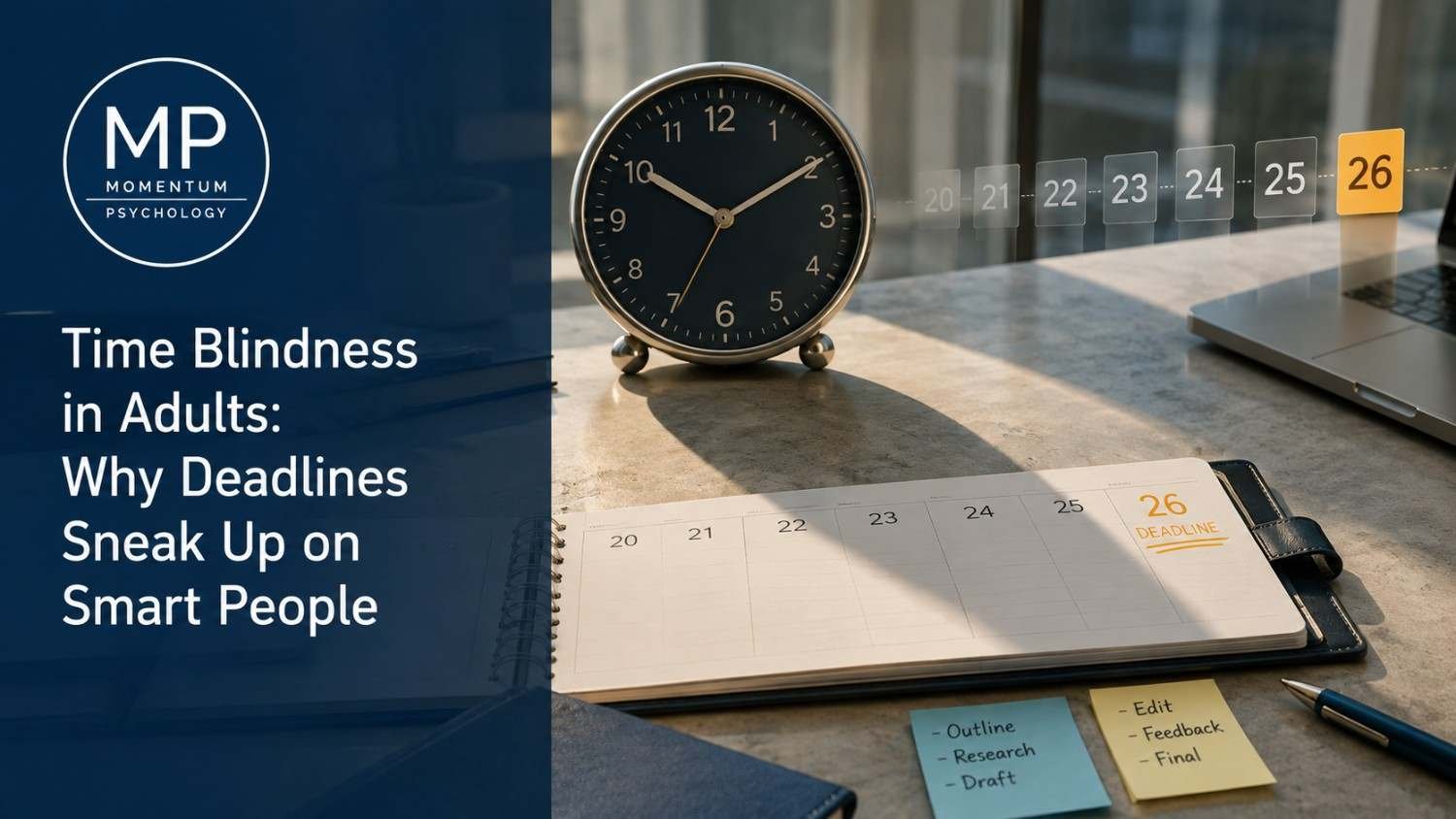
Time blindness is an informal term for difficulty noticing time passing, estimating task duration and turning future deadlines into present action. A deadline may feel distant until it suddenly becomes urgent. Intelligence does not automatically provide accurate time awareness. Although time blindness is often associated with ADHD, it is not diagnostic. External systems can make time and the steps between now and later more visible.
What Is Time Blindness in Adults?
Time blindness describes difficulty tracking, estimating or anticipating time. A person may know that a report is due Friday but struggle to sense its proximity, calculate the work or begin early enough. It is not a formal diagnosis.
It can involve four related difficulties:
- Not noticing how much time has passed
- Underestimating or overestimating task duration
- Failing to mentally represent a future deadline until it feels immediate
- Transitioning too late to arrive, stop or begin on time
Cleveland Clinic describes time blindness as a general way of discussing lost time awareness or difficulty estimating duration. Anyone can experience it occasionally, although its impact varies. Read Cleveland Clinic’s overview.
What Does Time Blindness Look Like?
Time blindness can appear across daily life:
- A Monday deadline feels remote until Thursday.
- A task expected to take 20 minutes consumes 90.
- You begin getting ready at the time you intended to leave.
- An interesting activity absorbs an afternoon without your noticing.
- You remember the due date but not its intermediate steps.
- Pressure becomes the only reliable trigger for focused work.
- Meetings are scheduled back-to-back without transition time.
- You promise to start earlier, then repeat the pattern.
Knowing the date is not the same as accurately sensing its proximity or converting it into action.
Why Do Deadlines Sneak Up on Smart People?
Deadlines can surprise capable adults because intelligence and time management are different capacities. Strong reasoning does not automatically create accurate estimates, sequencing, transition awareness or task initiation.
High achievers may compensate through anxiety, urgency, overpreparation or late nights. This can protect performance while hiding its cost until demands increase.
The issue is not that intelligent minds “work too fast.” Future work has not been represented accurately enough in the present.
Time Blindness vs Procrastination, Task Paralysis and Burnout
These patterns overlap, but they do not describe the same process.
| Pattern | Central difficulty | Typical experience | Relationship with deadlines | Common behavior | What may help |
| Time blindness | Tracking or estimating time | “I did not realize it was this late.” | Urgency appears suddenly | Starts later than intended | Visible time and checkpoints |
| Procrastination | Delaying intended action | “I keep postponing.” | Deadline is known | Chooses another activity | Identify the function of delay |
| Task paralysis | Initiating the first step | “I feel blocked.” | Deadline increases pressure | Stares, freezes or avoids | Define a small first action |
| Decision fatigue | Managing excessive choices | “What comes first?” | Planning consumes time | Keeps comparing options | Reduce options and clarify priorities |
| Burnout | Reduced capacity after stress | “I have no energy.” | Work feels harder as it approaches | Slows down or withdraws | Workload change and recovery |
If initiation is the main barrier, review ADHD task paralysis. If choices consume the workday, examine decision fatigue at work.
This table cannot diagnose the cause. Several mechanisms may be operating at once.
Does Time Blindness Mean You Have ADHD?
No. Time blindness does not establish ADHD. Adults with ADHD may struggle with time management, planning, organization and large projects, but many people experience situational time problems.
NIMH explains that adult ADHD involves persistent difficulties affecting multiple situations and beginning in childhood. Read the NIMH guide. Momentum’s overview of ADHD symptoms that adults often miss provides context.
Assessment considers developmental history, persistence, impairment and alternatives. The CDC notes that anxiety, depression, sleep problems, substance use and learning difficulties can resemble or overlap with ADHD. Read the CDC overview.
Adult ADHD time-perception research is limited and inconsistent. Laboratory timing tasks are not identical to managing real deadlines. Review the research.
Why High Achievers Can Hide Time Blindness
High performance shows the result, not its cost. A professional may meet deadlines through overnight work, panic, assistance or overpreparation.
Momentum’s discussion of ADHD masking in adults explains how polished performance can conceal exhaustion. Understanding executive dysfunction vs laziness moves the question from judgment to the process needing support.
Nine Strategies for Managing Time Blindness
No single tool solves every pattern. Test what improves follow-through.
1. Make Time Physically Visible
When hours disappear, keep an analog clock, visual countdown or timer in sight. For a 45-minute review, display the remaining time. A hidden timer provides only an ending alert; visible time provides continuous information.
2. Track Actual Task Duration
When estimates fail, record predicted and actual duration. If invoicing is predicted at 20 minutes but averages 50, schedule 50. Treat differences as planning data, not failure.
3. Replace One Final Deadline With Checkpoints
When deadlines feel unreal, create dated outputs: requirements, outline, draft, review and submission. Avoid vague checkpoints such as “work on report.” Concrete deliverables reveal delays while adjustment remains possible.
4. Schedule the Start Time, Not Only the Due Date
Add the first work session, not only the outcome. “Proposal due Friday” becomes “Draft three headings Tuesday at 10:00.” Avoid an unrealistic block. A specific start converts intention into behavior.
5. Add Transition and Interruption Buffers
Schedule stopping, saving, gathering materials and travel. A meeting ending at 2:00 does not permit a 2:00 departure. Transitions are not zero-time events; buffers expose their hidden steps.
6. Use Action-Specific Alarms
Label the required behavior: “Close document and leave,” not “Reminder.” Too many alerts become background noise; a specific cue reduces decision-making at the transition.
7. Define What “Done” Means
When perfectionism expands work, define completion first: “Accurate, proofread and ready for internal review.” Do not improve beyond the task’s purpose. A clear endpoint limits scope.
8. Add External Accountability
When private deadlines feel abstract, arrange a draft handoff or progress check. Send the outline to a colleague Wednesday morning. Accountability should create structure, not surveillance or shame.
9. Create a Missed-Time Rescue Plan
When behind, stop, calculate remaining work, reduce nonessential scope, communicate and revise the plan. Do not hide until completion. A preset response reduces further delay and protects trust.
Momentum’s guide to managing ADHD in the workplace provides additional ideas for structuring tasks and attention.
A Realistic Deadline-Planning Example
Suppose a report is due Friday at 3:00 p.m. A workable plan might be:
- Monday: Define requirements.
- Tuesday: Create the outline.
- Wednesday: Produce a working draft.
- Thursday morning: Review major issues.
- Thursday afternoon: Request missing information.
- Friday morning: Complete the final quality check.
- Friday at noon: Make the report submission-ready.
Noon is the practical internal deadline. The buffer absorbs interruptions and final corrections. A 2:55 p.m. target assumes nothing will go wrong.
What Should You Do After Missing a Deadline?
After missing a deadline, communicate promptly and repair the system. Avoid disappearing or promising an uncalculated completion time.
Use these steps:
- State the current status.
- Give a realistic revised time.
- Identify any decision or information you need.
- Complete the most important remaining work.
- Review which process failed.
- Add one preventive change.
- Separate accountability from character judgment.
For example:
“I missed today’s deadline. The analysis is complete, but the recommendations need review. I can deliver the report by 11:00 tomorrow. I have added an earlier review checkpoint.”
Understanding time blindness does not remove responsibility. It should improve communication, repair and future planning.
When Therapy or ADHD Assessment May Help
Professional support may help when time difficulties harm work or relationships, cause chronic lateness, require panic or lost sleep, produce shame or persist despite reasonable systems. It may also help when attention, organization, impulsivity or follow-through are involved.
ADHD therapy for adults may address functioning, avoidance, perfectionism and sustainable systems. An adult ADHD assessment examines whether ADHD or another explanation fits the broader history. Neither assumes ADHD is the answer.
How Momentum Psychology Helps With Time Blindness
Momentum Psychology provides doctoral-level online therapy and adult ADHD assessment for high-achieving adults and professionals.
Work may involve identifying executive-function barriers, externalizing time, improving transitions, addressing anxiety or perfectionism and building sustainable patterns. No treatment fits everyone.
If time blindness or compensatory overwork affects functioning, request a consultation to explore whether Momentum Psychology may fit your needs.
Frequently Asked Questions
What is time blindness in simple terms?
Time blindness is an informal description of difficulty noticing time passing, estimating duration or acting early enough for future commitments.
Is time blindness a formal diagnosis?
No. Time blindness is not a standalone diagnosis. It describes an experience that may have different causes and levels of impact.
Is time blindness always caused by ADHD?
No. It is commonly discussed with ADHD, but time-management difficulties can occur for many reasons. One pattern cannot establish a diagnosis.
Can you have time blindness without ADHD?
Yes. People without ADHD can lose track of time, particularly during absorbing activities, stress, insufficient sleep or periods of overload.
What does time blindness feel like?
It may feel as though time disappears, tasks have unpredictable duration or a future deadline suddenly changes from distant to urgent.
Is time blindness the same as procrastination?
No. Time blindness concerns tracking or estimating time. Procrastination means delaying an intended action. They can occur together.
Why do I underestimate how long tasks take?
You may overlook preparation, transitions, interruptions, decision-making or revision. Tracking actual duration can reveal which steps your estimate excludes.
How can I manage time blindness at work?
Make time visible, schedule starting points, create checkpoints, use action-specific alarms, add transition buffers and review actual task durations.
Can therapy help with time blindness?
Therapy may help identify the processes behind deadline problems, address emotional barriers and develop systems matched to the person’s needs.
Should I get assessed for ADHD?
Consider an assessment when time difficulties are longstanding, impairing, present across settings and accompanied by other attention or executive-function concerns.