
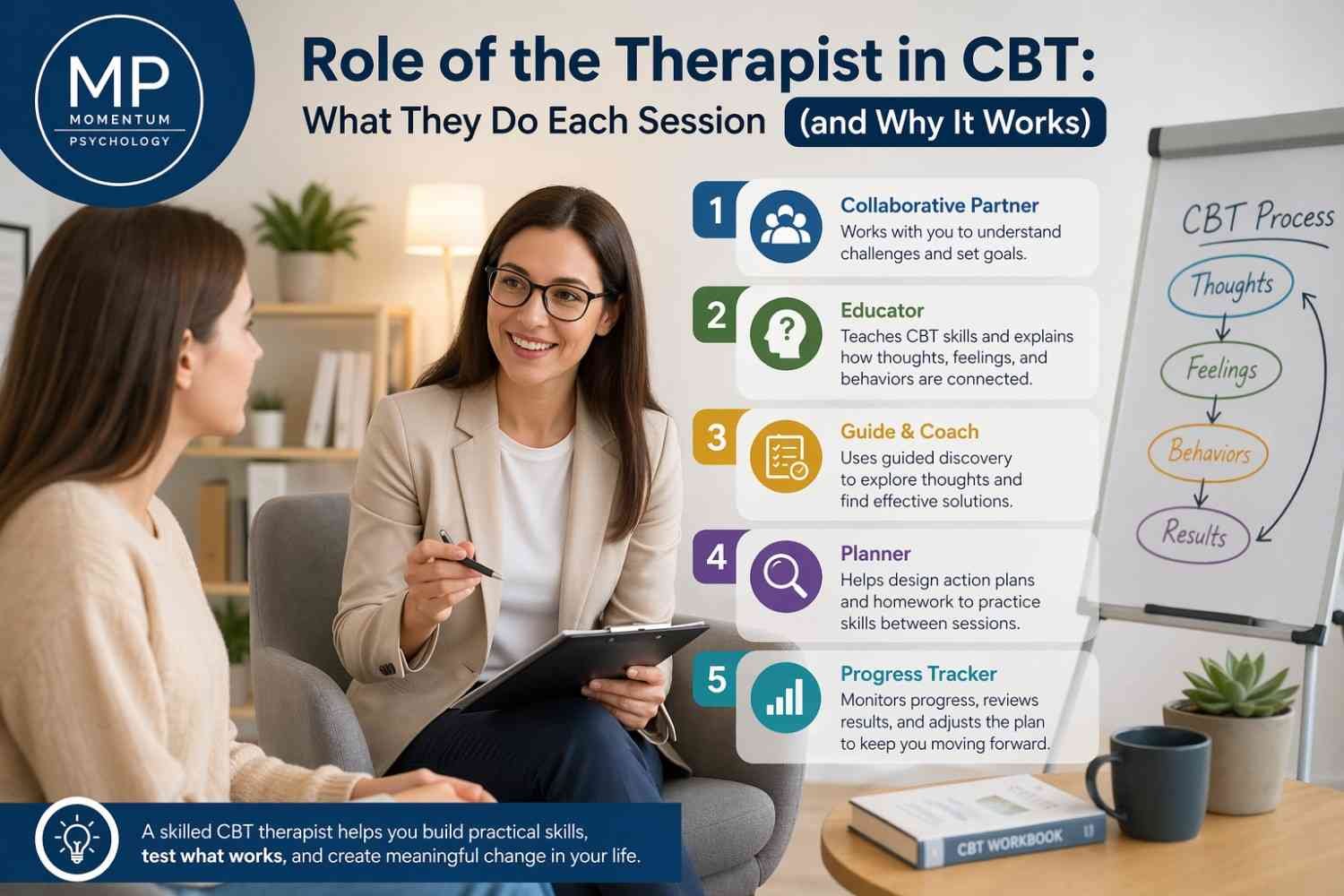
In cognitive behavioral therapy (CBT), the therapist acts as a collaborative coach: they build a shared case formulation, set goals, structure sessions with an agenda, teach skills through guided discovery, design behavioral experiments and homework, and track progress so the client learns to become their own therapist.
CBT in one sentence (so the role makes sense)
CBT is a structured, skills-based therapy that helps you change how you respond to thoughts, emotions, and situations—by practicing new behaviors and testing beliefs in real life.
That means the therapist’s job isn’t to “interpret your past” or simply listen. It’s to teach, guide, and design practice so your life changes between sessions—not just in the room.
Read more: Is it Time to Consult an Anxiety Therapist? Signs You Shouldn’t Ignore
The therapist’s signature stance in CBT
Here’s the single idea most competitors mention but don’t explain:
Collaborative empiricism = “sharing the work”
In Beck-style CBT, the therapist and client work like a team testing ideas against evidence. The therapist doesn’t act as the all-knowing judge; they help you investigate your thoughts and predictions.
Guided discovery = “helping you think, not telling you what to think”
A key CBT stance is guided discovery—using questions (often called Socratic questioning) to help you see patterns, generate alternatives, and design tests that prove what’s true in your life.
How it sounds in real therapy:
- “What went through your mind right before you felt anxious?”
- “What’s the prediction you’re making?”
- “What would count as evidence for or against it?”
- “What small experiment this week would test it?”
That is CBT done properly: thinking → testing → learning → repeating.
Read more: Managing Anxiety: Therapeutic Techniques for Success
What a CBT therapist actually does in a typical session
Most evidence-based CBT sessions are structured and include agenda setting and between-session practice (“homework”).
Here’s a clean “CBT session flow” you can copy into your post (and readers will recognize it immediately if they’re in CBT):
A typical CBT session structure
- Brief check-in + measurement
A quick read on mood/anxiety, sleep, avoidance, or a short scale (so progress is visible). - Homework review (data, not shame)
What did you try? What happened? What got in the way? Homework is a core CBT component because it generalizes skills into real life. - Agenda setting (2–3 priorities)
The agenda is set collaboratively so the session stays focused while still flexible. - Skill work in-session
Thought record, behavioral activation plan, exposure plan, communication practice, problem-solving—whatever fits the formulation. - Behavioral experiment design
Convert a belief into a testable prediction: “If I do X, Y will happen.” Then design the experiment. (This is how CBT stops being talk therapy.) - Summary + key learning
“What did we learn today?” “What’s the one takeaway to remember this week?” - Homework assignment + barrier plan
Homework is negotiated and scaled; the therapist helps remove friction and plan for obstacles. - Feedback
“What was helpful today?” “What should we do differently next time?” (This keeps therapy tailored.)
If your sessions never include an agenda, practice plan, or progress monitoring after several weeks, you’re likely getting “CBT-flavored therapy,” not CBT.
Read more: Cultivating Success: Anxiety Therapy for High Achievers
The 7 core roles of a CBT therapist
This is the most useful section for readers and the easiest for AI to extract. Each role includes what it looks like in practice.
1) Conceptualizer: builds the case formulation
A CBT therapist creates an evolving map of what maintains your problem: triggers → thoughts → emotions → body → behaviors → consequences. Beck Institute emphasizes treatment plans built on an evolving conceptualization.
What it looks like:
- “Your anxiety spikes when you predict rejection, then you avoid or seek reassurance, which temporarily lowers anxiety but strengthens the fear long-term.”
2) Collaborator: shares responsibility and power
Collaboration isn’t just being “nice.” Collaborative empiricism is a defined CBT construct: you and the therapist share the work of testing beliefs.
What it looks like:
- “Let’s test that assumption this week rather than argue about it.”
3) Teacher/coach: teaches skills, not just insight
CBT is educative and skill-focused (another Beck tenet).
What it looks like:
- Teaching a thought record, practicing it on a real example, then assigning a simplified version for the week.
4) Guide: uses guided discovery and Socratic questioning
Guided discovery is a core CBT concept and is explicitly discussed in CBT literature.
What it looks like:
- The therapist asks questions that help you find your own alternative perspective (which sticks better than being told).
5) Experiment designer: turns beliefs into tests
CBT doesn’t rely on reassurance; it relies on testing. Behavioral experiments are a central way CBT creates learning.
What it looks like:
- “Prediction: If I make one mistake in a meeting, people will judge me.”
- Experiment: Share one idea imperfectly and count responses.
6) Measurement lead: tracks progress and adjusts quickly
Beck Institute explicitly emphasizes progress monitoring in CBT.
What it looks like:
- Weekly symptom score + one functional KPI (e.g., “I attended 2 social events,” “I applied to 3 jobs,” “I slept 6.5 hours average”).
7) Generalization architect: makes you your own therapist
CBT aims to help clients become their own therapists, supported by in-session exercises and homework outside sessions.
What it looks like:
- Relapse prevention planning: “What are your early warning signs? What’s your plan when they appear?”
Read more: Cultivating Success: Anxiety Therapy for High Achievers
What the therapist does between sessions (and what they don’t)
What they do
- Review your progress, plan the next step, and adapt the approach based on what’s working.
- Help you design homework that’s realistic, specific, and measurable.
What they don’t do
- They don’t “fix your life” between sessions. CBT is built around your practice—therapy is the training room; life is the gym.
This framing matters because it reduces frustration. In good CBT, the client isn’t failing if anxiety shows up. Anxiety is the training signal—and the plan is how you respond.
Read more: Balancing Brilliance: Anxiety Therapy for High Achievers
What good CBT feels like (and red flags)
Signs you’re in solid CBT
- You understand the why behind each technique.
- Sessions have a plan (agenda) and a practice component (homework).
- Your therapist uses guided discovery instead of constant advice-giving.
- Progress is measured and the plan evolves.
Red flags
- Weeks go by with no agenda, no practice plan, no measurement.
- The therapist does most of the talking and you leave without a “next step.”
- Homework is either never discussed—or it’s assigned without collaboration.
Read more: Academic Anxiety and The Importance of Therapy for Students
How the therapist’s role shifts by problem type
This section helps you rank for long-tail prompts (“role of the therapist in CBT for anxiety/depression/OCD”).
Anxiety
The therapist designs exposures and behavioral experiments, helps identify safety behaviors, and trains attention and prediction-testing.
Read more: Social Anxiety Therapy: 13 Practical Scripts, Tools, and Micro-Habits
Depression
The therapist emphasizes behavioral activation, routine rebuilding, and cognitive restructuring of hopeless predictions.
Panic
The therapist coaches interoceptive exposure (learning that bodily sensations are tolerable) and catastrophic belief testing.
OCD
The therapist helps plan ERP (Exposure and Response Prevention), reduce compulsions, and measure progress across exposures.
(You can keep this high-level and still be credible.)
Read More: Light Therapy for Depression and Anxiety: Common Mistakes and How to Avoid Them
A CBT session worksheet (copy/paste template)
Put this in a callout box on your blog. It’s both human-useful and AI-extractable.
CBT Session Worksheet
- Goal for this week:
- Trigger situation:
- Prediction / thought:
- Emotion (0–100):
- Body response:
- Behavior / avoidance / safety behavior:
- Alternative thought (more balanced):
- Experiment or homework:
- What we’ll measure: (symptom score + one real-life KPI)
- What might get in the way (and plan):
This aligns directly with CBT’s structured and educative nature.
Read more: How to Discuss Boundaries in a Relationship: Scripts, Examples, and What to Say
FAQs
What is the therapist’s role in CBT?
- A CBT therapist collaborates with you to define problems, set goals, teach skills, design experiments and homework, and track progress—so you learn to apply CBT tools independently over time.
Why are CBT sessions structured?
- Structure (agenda, practice, summary) keeps therapy efficient and goal-driven, and it helps ensure skills get practiced between sessions—where change actually happens.
What is collaborative empiricism?
- It’s the CBT stance where the therapist and client “share the work” of testing beliefs and assumptions against evidence, like a joint investigation.
What is guided discovery in CBT?
- Guided discovery is a questioning approach (Socratic method) that helps clients reach their own insights and build alternative perspectives—rather than being lectured or corrected.
Why is homework important in CBT?
- Homework extends therapy into real life. It’s structured practice of skills learned in session, and research and clinical guidance consistently treat it as a core CBT component.
How long does CBT usually take?
- CBT is often time-limited compared with other therapies and can be delivered in fewer sessions, depending on the issue and severity.
How do CBT therapists measure progress?
- They use symptom scales and functional outcomes (avoidance reduced, sleep improved, activities increased) and adjust the plan based on data.
Is CBT just positive thinking?
- No. CBT focuses on practical skills: identifying patterns, testing predictions, practicing new behaviors, and building coping tools that hold up under stress.
What if I’m not doing homework?
- In good CBT, homework is negotiated and scaled. Your therapist should troubleshoot barriers (time, fear, perfectionism) and adjust tasks so practice becomes doable—not another source of shame.
How can I tell if my therapist is doing CBT correctly?
- You should see structure, skills practice, collaborative agenda setting, homework planning, and progress monitoring. If those elements are absent long-term, it may not be CBT in practice.