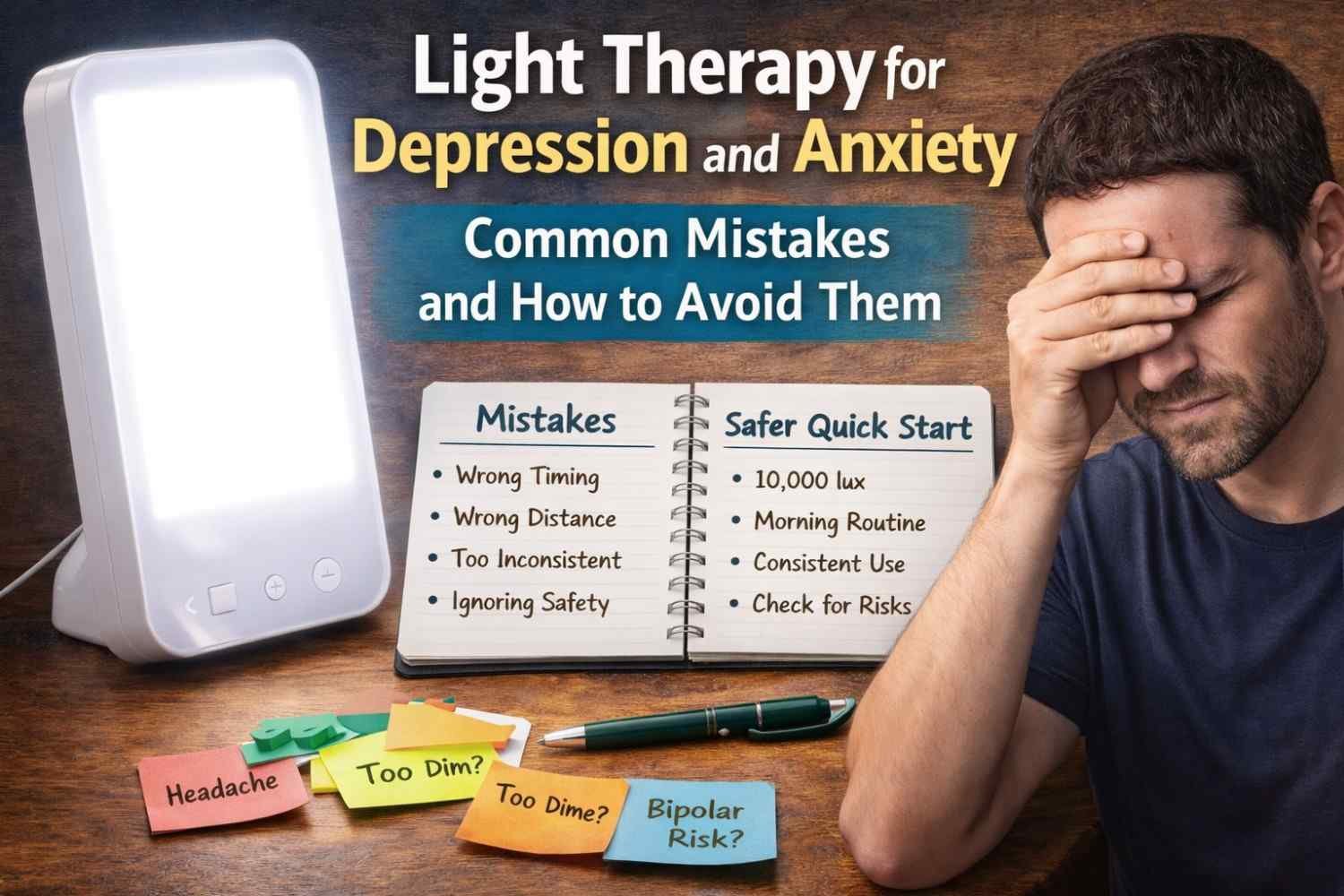
Bright light therapy works best when you treat it like a dose: right intensity, right timing, consistent routine. For many people, that means a 10,000-lux, UV-filtered light box, used in the morning for about 20–30 minutes, positioned ~16–24 inches from your face with eyes open but not staring directly at the light.
What this guide does: It shows the most common mistakes that make light therapy fail (or feel worse), how to fix them safely, and when you should stop DIY and get professional support.
Educational information only. If you feel unsafe or are thinking about self-harm, seek urgent help immediately.
Read more: Is it Time to Consult an Anxiety Therapist? Signs You Shouldn’t Ignore
Does light therapy help depression and anxiety?
Depression (strongest support in seasonal depression; growing evidence beyond)
Light therapy is a standard treatment option for seasonal affective disorder (SAD), with common guidance centered on 10,000 lux morning use.
For nonseasonal depressive disorders, a recent systematic review and meta-analysis found bright light therapy was an effective adjunctive treatment and may improve response time.
Anxiety (more limited and mixed)
Some research suggests bright light exposure can reduce anxiety symptoms modestly, but the evidence base is smaller and less definitive than for depression.
Translation: it may help some people (especially when anxiety is tied to sleep/circadian disruption), but it’s not a standalone “anxiety cure.”
Read more: Managing Anxiety: Therapeutic Techniques for Success
Before you start: a 45-second safety fit test (don’t skip this)
Light therapy is not “just a lamp.” It can shift circadian rhythms and, in some cases, mood states.
Consult a clinician first (don’t DIY) if you have:
- Bipolar disorder or recent/current mania/hypomania, mixed symptoms, or rapid cycling (light therapy can destabilize mood in vulnerable people).
- Significant retinal/eye disease or conditions/medications that increase photosensitivity.
- Severe insomnia, agitation, or panic spikes that worsen with activation (you’ll need a paced plan).
If that’s you, this post still helps—but your “mistake-proof” plan should be supervised.
Read more: Navigating Entrepreneurial Anxiety: Therapy Solutions
The correct setup (the part most people get wrong)
Baseline protocol (most commonly recommended):
- Intensity: 10,000 lux (at the specified distance)
- Timing: within the first hour of waking, generally morning is best; later use can trigger insomnia
- Duration: 20–30 minutes (often)
- Distance: about 16–24 inches (device-dependent)
- Eyes: open, not staring directly at the light
- UV: device should filter most or all UV
Now let’s make it work in the real world.
Read more: Cultivating Success: Anxiety Therapy for High Achievers
12 common light therapy mistakes (and exactly how to fix each)
Mistake 1: Buying a “bright” lamp that isn’t a therapy light
What happens: No change after weeks, or you feel “wired” without mood benefit.
Why: Many lamps don’t deliver therapeutic lux at eye level. Light boxes vary widely in intensity.
Fix: Use a 10,000-lux light box from a reputable manufacturer that specifies lux at a given distance.
Mistake 2: Sitting too far away
What happens: You do it “daily” but nothing changes.
Why: Lux drops rapidly with distance; your eyes may be getting a fraction of the intended dose. Practical recommendations often land around 16–24 inches.
Fix: Move the light to the device’s recommended distance and keep positioning consistent.
Mistake 3: Using it too late in the day
What happens: Insomnia, restless sleep, next-day anxiety.
Why: Evening light can shift circadian timing and increase alertness. Morning is typically recommended; later use may cause insomnia.
Fix: Move sessions earlier—ideally within the first hour of waking.
Mistake 4: Going “all in” on day one
What happens: Headaches, nausea, agitation, eye strain—then you quit.
Why: Your system may need a ramp-up, especially if you’re sensitive or anxious.
Fix: Start with 10–15 minutes for a few days, then increase toward 20–30 minutes as tolerated. This aligns with common clinical guidance that shorter exposure can still be useful, especially early on.
Mistake 5: Expecting instant results (and stopping too early)
What happens: You quit after 3 days because you “don’t feel different.”
Reality: Some people notice improvements within days, but full benefit may take around two weeks.
Fix: Commit to 14 days of consistent use before judging effectiveness (unless side effects are significant).
Mistake 6: Being inconsistent (random days, random times)
What happens: You get brief lifts followed by crashes, or no clear pattern.
Why: Light therapy works best as a circadian cue—random timing is weaker. Morning consistency is commonly emphasized.
Fix: Pick a time window (e.g., within 30–60 minutes of waking) and stick to it.
Mistake 7: Staring directly at the light
What happens: Eye strain, headaches, “this feels unsafe.”
Why: Guidance typically says eyes open but not looking directly at the light.
Fix: Angle it slightly to the side or above eye level and do another task (breakfast, reading).
Mistake 8: Ignoring UV safety
What happens: Worry about eye/skin exposure—or real irritation with the wrong product.
Why: Light boxes should filter out most or all UV; if you’re unsure, confirm with the manufacturer.
Fix: Use a UV-filtered device and be extra cautious if you have eye conditions or photosensitizing meds.
Mistake 9: Assuming “blue light is better”
What happens: You chase color temperature and forget dosage and timing.
Why: Some guidance indicates no clear advantage of blue vs white for typical SAD light boxes; the bigger variable is intensity and timing.
Fix: Prioritize lux, UV filtering, timing, distance, consistency over “blue vs white.”
Mistake 10: Using light therapy like a stimulant for fatigue
What happens: Short-term alertness, but mood doesn’t improve and anxiety may rise.
Why: Light can boost alertness—especially if you’re sleep-deprived—but depression/anxiety improvement usually requires consistent circadian alignment and/or adjunctive treatment.
Fix: Treat it as a daily protocol, not a rescue tool.
Mistake 11: Skipping bipolar screening
What happens: Mood becomes unusually elevated, irritable, or you sleep less but feel “fine.”
Why: Clinical recommendations note light therapy is contraindicated with current/recent mania/hypomania/rapid cycling and should be monitored when bipolar risk is present.
Fix: If you have bipolar history (or a strong family history), don’t DIY—get a clinician-led plan and mood monitoring.
Mistake 12: Treating light therapy as a replacement for comprehensive care
What happens: You delay effective therapy or medication when symptoms are impairing.
Why: For many people, bright light therapy is best as an adjunct for nonseasonal depression, not the only intervention.
Fix: Use light therapy as one lever in a plan that may include CBT, sleep work, exercise, and/or medication where appropriate.
Read more: Cultivating Success: Anxiety Therapy for High Achievers
Troubleshooting: symptom → likely cause → fix
Use this table to self-correct without guessing.
| What you notice | Likely cause | Fix to try (48–72 hours) | Stop DIY and get help if… |
| Headache/eye strain | Too close / too long / staring at light | Increase distance, reduce duration, don’t stare directly | Eye pain, visual changes, persistent symptoms |
| Insomnia | Too late in day | Move to morning (first hour after waking) | Severe sleep loss, agitation, panic escalation |
| Jittery/anxious | Dose too high for you / sleep debt | Shorter sessions + earlier timing; stabilize wake time | Anxiety becomes unmanageable, severe agitation |
| No improvement after 2 weeks | Dose inconsistent / too dim / wrong distance | Verify 10,000 lux at distance; improve consistency | Depression worsening, functional decline |
| Mood “too up,” less sleep | Bipolar activation | Stop and consult clinician | Any hypomanic/manic symptoms |
A mistake-proof 14-day plan (simple, measurable)
Days 1–3: 10,000 lux, morning, 10–15 min
Days 4–7: increase toward 20 min
Days 8–14: 20–30 min as tolerated, same morning window daily
Track 3 things: sleep quality, mood (0–10), anxiety (0–10)
This approach respects common protocol guidance while giving sensitive people a safer ramp.
Read more: Balancing Brilliance: Anxiety Therapy for High Achievers
When to get professional help (clear decision rules)
Light therapy is a useful tool—but if any of these are true, don’t “optimize harder,” escalate your support:
- Symptoms are impairing work/relationships
- Depression is persistent or worsening
- Anxiety is severe, panic-driven, or tied to trauma
- You suspect bipolar spectrum symptoms (past “up” episodes, decreased need for sleep)
Read more: Academic Anxiety and The Importance of Therapy for Students
If you want light therapy to be part of a real treatment plan (not a stand-alone experiment), the highest-yield clinical move is to pair it with structured therapy that targets the mechanisms that keep depression/anxiety stuck—sleep disruption, avoidance, rumination, and stress physiology. Bright light therapy shows benefit as an adjunct for nonseasonal depressive disorders, which makes integrated care a practical pathway when symptoms are persistent.
FAQs
What time should I use light therapy?
- Morning is usually best, ideally within the first hour of waking. Using light therapy later in the day can cause insomnia in some people.
How long should I use a 10,000-lux light box?
- A common recommendation is 20–30 minutes daily (some people start lower and ramp up). Brighter boxes generally require less time than dimmer ones.
How far should the light box be from my face?
- Typical guidance is around 16–24 inches, but the correct distance depends on the device’s specifications because intensity at the eye changes with distance.
How long does light therapy take to work?
- Some people notice improvement within a few days, but it may take about two weeks to reach full benefits for seasonal depression patterns.
Can light therapy make anxiety worse?
- It can – usually when timing is too late, duration is too long, or sleep is already unstable. If anxiety spikes, reduce duration, move earlier, and stabilize sleep; if symptoms worsen significantly, seek professional guidance.
Is light therapy safe for my eyes?
- Most SAD light boxes are designed to filter most or all UV, and guidance recommends not staring directly at the light. If you have eye disease or photosensitivity risks, consult your clinician before use.
Can people with bipolar disorder use light therapy?
- Light therapy can pose risks for mood switching in bipolar disorder. Clinical recommendations caution against use during current/recent mania or hypomania and emphasize clinician guidance and monitoring.
Does light therapy help nonseasonal depression?
- A systematic review and meta-analysis found bright light therapy can be an effective adjunctive treatment for nonseasonal depressive disorders and may improve response time.