
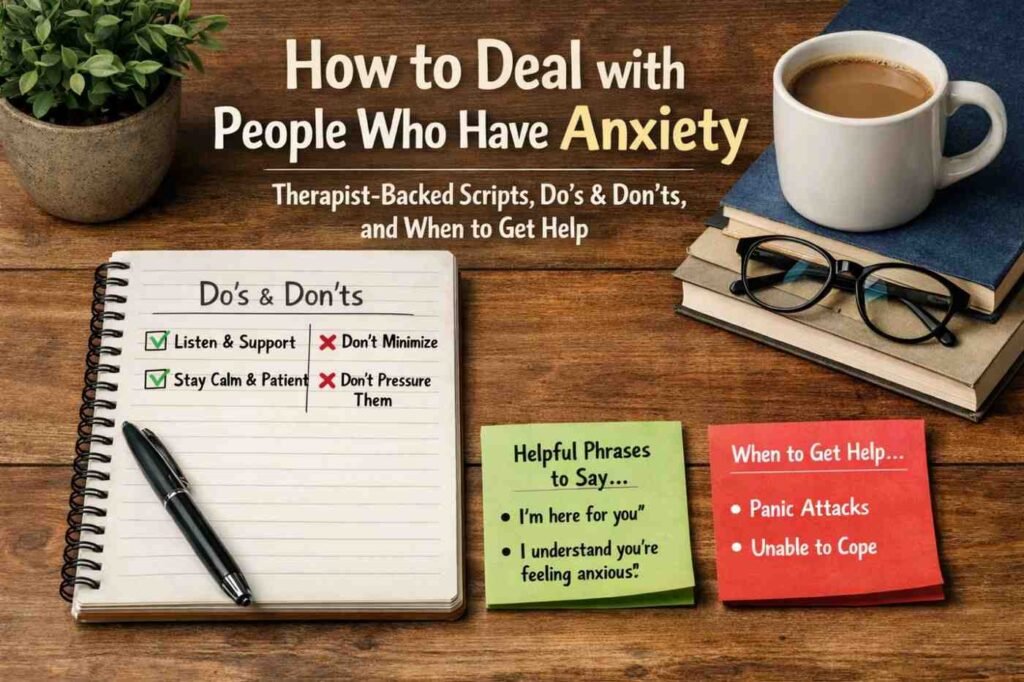
The best way to support someone with anxiety is to stay calm, listen without judgment, validate feelings, ask what helps, avoid minimizing or pressure, and encourage professional help when anxiety disrupts daily life. During panic, guide slow breathing, move to a quieter area if possible, and seek medical help if symptoms don’t settle.
Read more: Is it Time to Consult an Anxiety Therapist? Signs You Shouldn’t Ignore
What “anxiety” means
Anxiety can be a normal stress response or part of a condition like generalized anxiety disorder, panic disorder, social anxiety, or phobias. Effective treatments include talking therapies like CBT and, when appropriate, medication—decisions best made with a clinician.
Why this matters to supporters: Understanding that anxiety involves thoughts, physical symptoms (e.g., heart racing, breathlessness), and avoidance helps you respond to the process—not just the feelings. It also frames therapy as a practical, teachable skill set rather than a sign of weakness.
Read more: How to Help Someone with Anxiety: 5 Compassionate Techniques
What to say (and not say): 8 quick scripts you can use today
Validate, ask preferences, offer practical help, and set kind boundaries. Avoid minimizing (“Just relax”), forced exposure, or endless reassurance loops.
- Validate + relocate (if overstimulated)
“It makes sense you’re stressed—want to sit somewhere quieter for a minute?” (Validation lowers arousal; a calmer setting helps the body settle.) - Ask needs explicitly
“What would help most right now—listening, problem-solving, or a distraction?” (Let the person choose the kind of support.) - Panic moment—coach the breath
“Let’s breathe slowly together: in through your nose, out through your mouth.” If symptoms don’t subside or safety is a concern, get medical help. - Reduce reassurance loops
“I care about you. Instead of me answering the same worry, let’s write it down and check it tomorrow.” (Reassurance can become a safety behavior; gentle limits help.) - Offer practical help
“Want me to sit with you while you call the clinic or come to the first appointment?” (Logistics are often the barrier.) - Boundaries + care
“I’m here for you, and I’ll check in after class at 7. Can we text then?” (Support + predictability protects both of you.) - After a wobble—reinforce learning
“You did something hard today. What worked, and what should we tweak next time?” (Encourages reflection over rumination.) - Normalize professional help
“This seems heavy. Would you be open to seeing a GP/therapist? I can help you find one.” (Early help improves outcomes.)
Read more: Managing Anxiety: Therapeutic Techniques for Success
Do’s and Don’ts (evidence-guided)
| Do | Why it helps | Don’t | Why it backfires |
| Listen, validate, and stay calm | Reduces arousal and stigma | “Just calm down / it’s in your head” | Minimizes and can intensify distress |
| Ask what helps; follow preferences | Tailors support; builds trust | Force advice or exposure | Can feel unsafe; harms trust |
| Encourage GP/therapist when life is impacted | Connects to proven care (CBT, talking therapies) | Dismiss professional help | Delays effective treatment |
| Offer practical help (notes, appointments, chores) | Reduces overwhelm; increases follow-through | Take over everything | Can enable avoidance |
| Support healthy routines (sleep, movement, caffeine limits) | Lifestyle can reduce symptom load | Use groups instead of care | Peer groups supplement, not replace treatment |
Sources: NHS, NIMH, Mind, ADAA, Cleveland Clinic.
Read more: Navigating Entrepreneurial Anxiety: Therapy Solutions
How to help during a panic attack (for non-clinicians)
Ask permission to help, speak slowly, move to a quieter space if possible, and guide slow breathing. If it doesn’t subside or you’re worried about safety, seek medical help.
4-step approach you can memorize:
- Permission + presence: “I’m here. Want help focusing on your breath?” Stay with them; use short, calm sentences.
- Slow Breathing: In through the nose, out through the mouth; match your pace to theirs.
- Grounding: Invite noticing three things they can see/hear/feel; keep it gentle.
- Escalate if needed: If symptoms don’t ease or you’re concerned, seek medical input (e.g., NHS 111 in the UK; local urgent services elsewhere).
Read more: Cultivating Success: Anxiety Therapy for High Achievers
When to suggest professional help (and how to make it easier)
If anxiety lasts weeks, causes frequent panic, disrupts school/work/sleep/relationships, or leads to increasing avoidance, suggest seeing a GP or licensed therapist. Offer to help with search, questions for the appointment, and logistics.
Make the first step concrete:
- Research options together (GP, evidence-based therapy, local services).
- Prep the appointment: Write 3–5 questions and top concerns; bring notes.
- Offer to go along (even just the waiting room).
- Suggest reputable info (NIMH over random forums).
“Support” vs “enabling”: finding the line
Comfort is caring; avoiding everything hard isn’t. Endless reassurance, doing tasks for the person, or shielding them from all discomfort can keep anxiety in charge. Aim for kind support + small, agreed steps.
Practical test: Ask, “Is what I’m doing helping them move toward what matters—or helping them move away?” If it’s the latter, redesign the support (e.g., “I’ll walk with you to the door, and you’ll take the first two minutes from there”).
Read more: Balancing Brilliance: Anxiety Therapy for High Achievers
Self-care and boundaries for supporters
You’re most helpful when you aren’t depleted. Set times you’re available, encourage other supports, and get guidance if you’re unsure. Simple acts—shared walks, chores, and check-ins—can make a big difference.
Boundary scripts you can borrow:
- “I can talk until 8:30, then I need to study. Can we check in tomorrow after school?”
- “I can help list questions for your GP today, but I won’t be able to text during my shift.”
If you’re ever seriously worried about someone’s immediate safety, escalate to emergency services in your area; in the UK, call 999/A&E. Guidance on supporting someone in crisis is available from trusted charities.
Read more: Academic Anxiety and The Importance of Therapy for Students
7 micro-habits that actually help (for friends & family)
- Use names and warmth: “I’m here, Ali. Let’s take this one step at a time.” (Personalization reduces threat.)
- Offer choices, not commands: “Want a short walk or to sit somewhere quieter?” Choice restores control.
- Track what works: Keep a tiny “helpful list” (what language calms, which settings help). Reuse it.
- Encourage routine basics: Sleep routine, movement, balanced caffeine; these are small levers with outsized impact.
- Model calm tech use: Avoid doom-scrolling beside them; suggest a shared offline activity.
- Celebrate effort, not outcomes: “You went even though it felt rough—huge.” Reinforces approach behaviors.
- Know your lane: You’re a supporter, not a therapist. Help connect to care when needed.
Read more: Therapy for Entrepreneurs: Addressing Anxiety and Stress
Momentum Psychology: turn support into a simple plan
Why Momentum Psychology for Anxiety Support
• Doctoral-level clinicians (CBT/ACT/ERP) focused on practical skills
• Mechanism-first plans that reduce avoidance and reassurance cycles
• Progress you can see: simple weekly dashboards and clear next steps
• Online across PSYPACT states (where permitted)
Want a one-page support plan for your situation? Book a brief consult and leave with tailored scripts, boundaries, and first steps mapped.
In-article proof (place after “When to suggest help”):
We help families and partners coach without over-reassuring, set kind boundaries, and align support with the person’s therapy goals—so everyone knows exactly what to do next.
Ready for a calm, supportive game plan? Momentum Psychology designs family-friendly support playbooks and coordinates with your therapist. Request a consult to start.
What’s the kindest first response to someone with anxiety?
- Listen without judgment, validate how they feel, and ask what support would help most—listening, problem-solving, or a brief distraction.
Is breathing actually helpful during panic?
- Yes. Slow breathing and a quieter space can reduce symptoms for many people; seek medical help if symptoms don’t settle or you’re worried about safety.
When should I nudge someone toward therapy?
- If anxiety lasts weeks or disrupts school/work/sleep/relationships, encourage a GP/therapist and offer practical help with the first step.
- They can help some people but don’t replace professional care—consider them an add-on.
- Regular movement, a sensible sleep routine, and moderating caffeine can support recovery alongside therapy.