
If your child or teen is anxious, your job is not to erase anxiety in the moment. Your job is to calm without feeding avoidance and teach “brave reps” over time.
Use this 3-step loop:
- Regulate (your calm is the cue)
- Validate (feelings make sense; fear isn’t the boss)
- Coach one small next step (graded exposure / Fear Ladder)
Avoid the two fuel sources:
- Reassurance loops (answering the same worry question repeatedly)
- Accommodation (rescuing, speaking for them, changing life to avoid triggers)
These principles line up with mainstream child anxiety guidance and exposure-based CBT tools.
Read more: Is it Time to Consult an Anxiety Therapist? Signs You Shouldn’t Ignore
A quick safety note
This article is educational, not medical advice. If your child or teen is in immediate danger, talking about self-harm, or cannot stay safe, seek urgent local help right away (in the U.S., you can call/text 988).
The one distinction that changes everything
Calm the moment vs shrink anxiety long-term
Many caring parents accidentally train anxiety to grow by doing what works short-term:
- reassuring repeatedly
- negotiating endlessly
- helping them avoid the feared thing
Long-term improvement comes from:
- validation without debating the fear
- consistent boundaries around reassurance/accommodation
- repeated “hard-but-doable” steps toward the feared situation (graded exposure)
Read more: Managing Anxiety: Therapeutic Techniques for Success
What anxiety looks like in kids vs teens
Anxiety isn’t always “I’m worried.” It can look like:
Kids (often):
- stomachaches/headaches before school or activities
- clinginess, tantrums, bedtime battles
- avoidance (“I can’t,” “I’m sick,” “I forgot”)
Teens (often):
- irritability, shutdown, perfectionism, procrastination
- “I don’t care” (when they care a lot)
- social avoidance, school refusal, sleep disruption
A key signal to watch: anxiety starts interfering with school, home, or social life.
Read more: Navigating Entrepreneurial Anxiety: Therapy Solutions
The parent framework behind every good script
1) Regulate first
Your face, voice, and pacing tell your child whether this is safe. Before you speak:
- slow your voice
- soften your eyes
- exhale longer than you inhale
2) Validate feelings (without agreeing with the fear)
Validation: “This feels scary.”
Not validation: “You’re right, it’s dangerous.”
Child anxiety resources consistently recommend open-ended questions and avoiding patterns that intensify the worry cycle.
3) Coach one “brave step”
Your target is action while anxious, not “no anxiety.” Exposure tools like Fear Ladders exist for a reason: anxiety shrinks when your child learns they can handle discomfort.
Read more: Cultivating Success: Anxiety Therapy for High Achievers
The two habits that secretly feed anxiety
Reassurance loops
If you answer the same “What if…?” question ten times, you may get ten minutes of relief—and a stronger habit of reassurance-seeking. (We’ll fix this with Script #7.)
Accommodation
Accommodation = changing routines or doing rescues to prevent distress:
- speaking for them
- letting them skip the feared situation
- doing tasks they can do
- repeatedly checking/confirming safety
- reorganizing family life around anxiety
Accommodation is repeatedly linked to worse anxiety patterns and outcomes.
Quick table: what your child learns
| Parent move | What it teaches (unintentionally) | Better replacement |
| “You don’t have to go.” | “Avoidance keeps me safe.” | “We’ll do a small step together.” |
| “I’ll answer again.” | “I need certainty to cope.” | “We use our plan, not reassurance.” |
| “I’ll do it for you.” | “I can’t handle discomfort.” | “I’ll coach you through it.” |
Read more: Cultivating Success: Anxiety Therapy for High Achievers
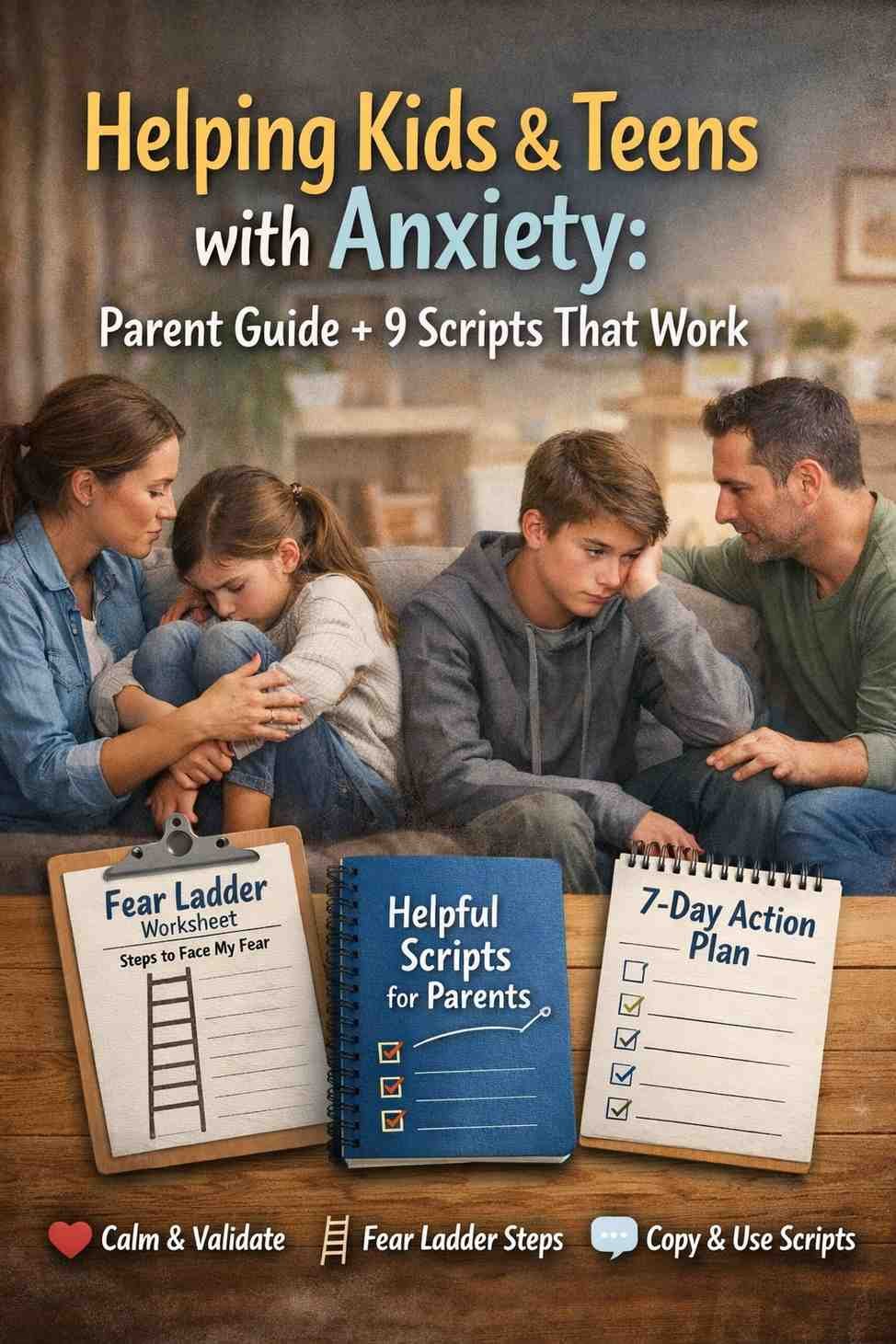
9 Scripts That Work (copy/paste)
Use these scripts word-for-word. The power is consistency.
Script 1: Validate + confidence (no debate)
Use when: panic, tears, “I can’t,” catastrophic talk.
Say this:
“I can see you’re really scared. That makes sense.”
“I’m here, and I believe you can handle this feeling.”
“We’ll take one small step together.”
Why it helps: validation reduces shame; confidence blocks the fear from becoming the decision-maker.
Try not to say: “You’re fine. Stop.” (often escalates)
Next step: ask for the smallest doable action: “What’s the first 2-minute step?”
Script 2: Open questions (stop feeding worry)
Use when: you’re tempted to ask “Are you anxious?”
Say this:
“How are you feeling about it?”
“What part feels hardest?”
“What would help you take one small step?”
Why it helps: open questions reduce “priming” and keep the conversation from spiraling.
Try not to say: “Are you worried about the test?”
Next step: summarize their answer in one sentence (“So the hardest part is…”) then move to a brave step.
Script 3: Body anxiety (name it, locate it, ride it)
Use when: stomachaches, nausea, “I feel weird,” pre-event symptoms.
Say this:
“That sounds like anxiety showing up in your body.”
“Where do you feel it—stomach, chest, throat?”
“Let’s do 3 slow breaths and watch it like a wave.”
Why it helps: labeling reduces panic and teaches observation instead of escape.
Try not to say: “Nothing is wrong with you.”
Next step: after 60 seconds, do a micro-action (shoes on, backpack, walk to the car).
Script 4: “Maybe worry” vs “likely worry” (and a coping plan)
Use when: endless “What if…?” scenarios.
Say this:
“Is that a worry or a likely worry?”
“If this happens, what’s our Plan A?”
“Now—what’s the next small step today?”
Why it helps: shifts from rumination to coping (without pretending nothing can go wrong).
Try not to say: “That won’t happen.” (you can’t guarantee it)
Next step: write the plan on a sticky note (“If X, then Y”), then return to the brave step.
Script 5: Brave step language (graded exposure, not forcing)
Use when: avoidance is the main coping strategy (school, bedtime, social).
Say this:
“We’re not aiming for zero fear.”
“We’re aiming for hard-but-doable.”
“Pick a 2-minute brave step.”
Why it helps: this is the logic of Fear Ladders and graded exposure—small steps repeated until anxiety drops.
Try not to say: “Just do it.” (power struggle ≠ exposure)
Next step: set a timer for 2 minutes; praise the attempt, not the outcome.
Read more: Balancing Brilliance: Anxiety Therapy for High Achievers
Script 6: “I won’t accommodate, and I won’t abandon you”
Use when: they want you to rescue/replace their coping (speak for them, do tasks, remove triggers).
Say this:
“I’m not going to do that for you, because I believe you can do it.”
“I will stay close and help you practice step by step.”
Why it helps: reduces accommodation while increasing supportive presence—exactly the pattern parent-based approaches target.
Try not to say: “Fine, I’ll do it.” (fast relief, long-term cost)
Next step: decide what you’ll help with (coaching) vs what you won’t do (rescuing).
Script 7: Reassurance loop interrupter (kind boundary)
Use when: the same worry question repeats (“Promise?” “Are you sure?”).
Say this:
“I already answered that once. Anxiety wants us to repeat it.”
“We’re using our plan now: 3 breaths + one brave step.”
Why it helps: it stops reinforcing reassurance-seeking and redirects to coping.
Try not to say: “Stop asking!” (shame escalates)
Next step: create a “one-answer rule” and post it: “We answer once, then we practice.”
Read more: Academic Anxiety and The Importance of Therapy for Students
Script 8: School anxiety / school refusal (calm, firm, specific)
Use when: morning meltdowns, “I can’t go,” frequent nurse visits, school avoidance.
Say this:
“I know mornings are hard.”
“School is still happening.”
“We’re doing the next step: shoes → car → walk to the door.”
Why it helps: consistent return reduces avoidance reinforcement; you’re building tolerance with structure.
Try not to say: “We’ll see.” (creates negotiation loops)
Next step: use the teacher email below.
Teacher/counselor email (paste-ready):
Hi [Name] — We’re working on anxiety skills at home. If [Student] feels overwhelmed, can we use a brief reset plan (2–3 minutes) and then return to task? Helpful options: quick water break, one grounding breath cycle, or a short check-in, then back to class. Thank you for supporting consistent return rather than prolonged avoidance.
Script 9: Teen autonomy (avoid power struggles)
Use when: teen shuts down, gets defensive, or says “leave me alone.”
Say this:
“I’m not here to control you.”
“I’m here to help your life get bigger than anxiety.”
“Do you want me to listen first, or help you choose one small next step?”
Why it helps: teens need agency; collaborative choice increases engagement.
Try not to say: “You’re being dramatic.”
Next step: agree on one measurable micro-step (text one friend, attend first period, submit one assignment).
Build a Fear Ladder in 10 minutes (the tool that makes anxiety shrink)
A Fear Ladder is a list of steps from least scary to most scary for one goal—then you practice the steps gradually.
Step 1: Pick one goal (narrow)
Examples:
- “Go to school and stay through first period”
- “Sleep in my room”
- “Talk to one classmate”
Step 2: Write 8–12 steps (0–10 fear rating)
Start easy. Build upward.
Step 3: Practice the middle steps first
Repeat a step until fear drops (or becomes manageable), then move up.
Example Fear Ladder: social anxiety (teen)
- Make eye contact and smile at a classmate (2/10)
- Say “hey” (3/10)
- Ask one simple question (“How was the quiz?”) (5/10)
- Sit with a group for 5 minutes (6/10)
- Stay for 15 minutes (7/10)
- Invite one person to study (8/10)
A simple 7-day parent plan
Day 1: Choose one goal + build the Fear Ladder
Day 2: Standardize one script (start with #6 or #7)
Day 3: Practice one ladder step for 2 minutes
Day 4: Reduce one accommodation (pick the easiest)
Day 5: Practice again + praise effort (“You did the hard step even scared.”)
Day 6: Coordinate school support (Script #8 email)
Day 7: Review what worked, adjust the ladder, repeat
Read More: Light Therapy for Depression and Anxiety: Common Mistakes and How to Avoid Them
When to get professional help (and what evidence-based care looks like)
Consider professional help when anxiety:
- affects school, home, or social life daily
- keeps escalating
- leads to school refusal, sleep collapse, or major avoidance patterns
- includes panic attacks or safety concerns
Evidence-based treatment options:
AACAP’s clinical practice guideline supports CBT for children and adolescents with anxiety disorders and also supports SSRIs as effective options depending on severity and response (treatment decisions should be made with qualified clinicians).
How Momentum Psychology can support parents (soft, relevant)
If the biggest driver in your home is accommodation (you’re constantly rescuing, negotiating, or reorganizing life around anxiety), Momentum offers SPACE — Supportive Parenting for Anxious Childhood Emotions, a parent-only approach designed to build your skills to help your child or teen face anxiety with less accommodation. (Internal link: /space/)
If your teen needs direct support, Momentum provides online therapy for teens .
For broader parent coaching and parent-child relationship support, see parents.
FAQs
What should I say to my anxious child right now?
- Validate what you see, communicate confidence, then coach one small step. Don’t debate the fear or repeat reassurance endlessly.
Does reassurance make anxiety worse?
- Repeated reassurance can become a loop: it relieves anxiety briefly and trains the brain to seek reassurance again. Shift to “validate + plan + brave step.”
What is parental accommodation in child anxiety?
- Accommodation is when parents change routines or rescue a child to prevent distress (including repeated reassurance), strengthening avoidance over time.
What is a Fear Ladder?
- A Fear Ladder is a graded list of steps toward one goal, practiced from easier to harder steps until anxiety decreases.
How do I help my teen with anxiety without pushing them away?
- Offer autonomy: ask whether they want listening or help choosing a small step. Collaborate instead of controlling.
When should we get professional help?
- When anxiety interferes with school, home, or social life regularly, or when avoidance keeps expanding.
What treatments are evidence-based for kids and teens with anxiety?
- AACAP guidance supports CBT and also supports SSRIs as options depending on severity/response, guided by clinicians.
What is SPACE therapy?
- SPACE is a parent-based approach that helps reduce accommodation and increase supportive responses—often without requiring the child to participate directly.
Can online therapy help teens with anxiety?
- Online therapy can improve access and provide structured support for teens when clinically appropriate.
What if my child refuses school because of anxiety?
- Use calm consistency, reduce negotiation, and focus on graded return steps with school collaboration rather than reinforcing avoidance.