
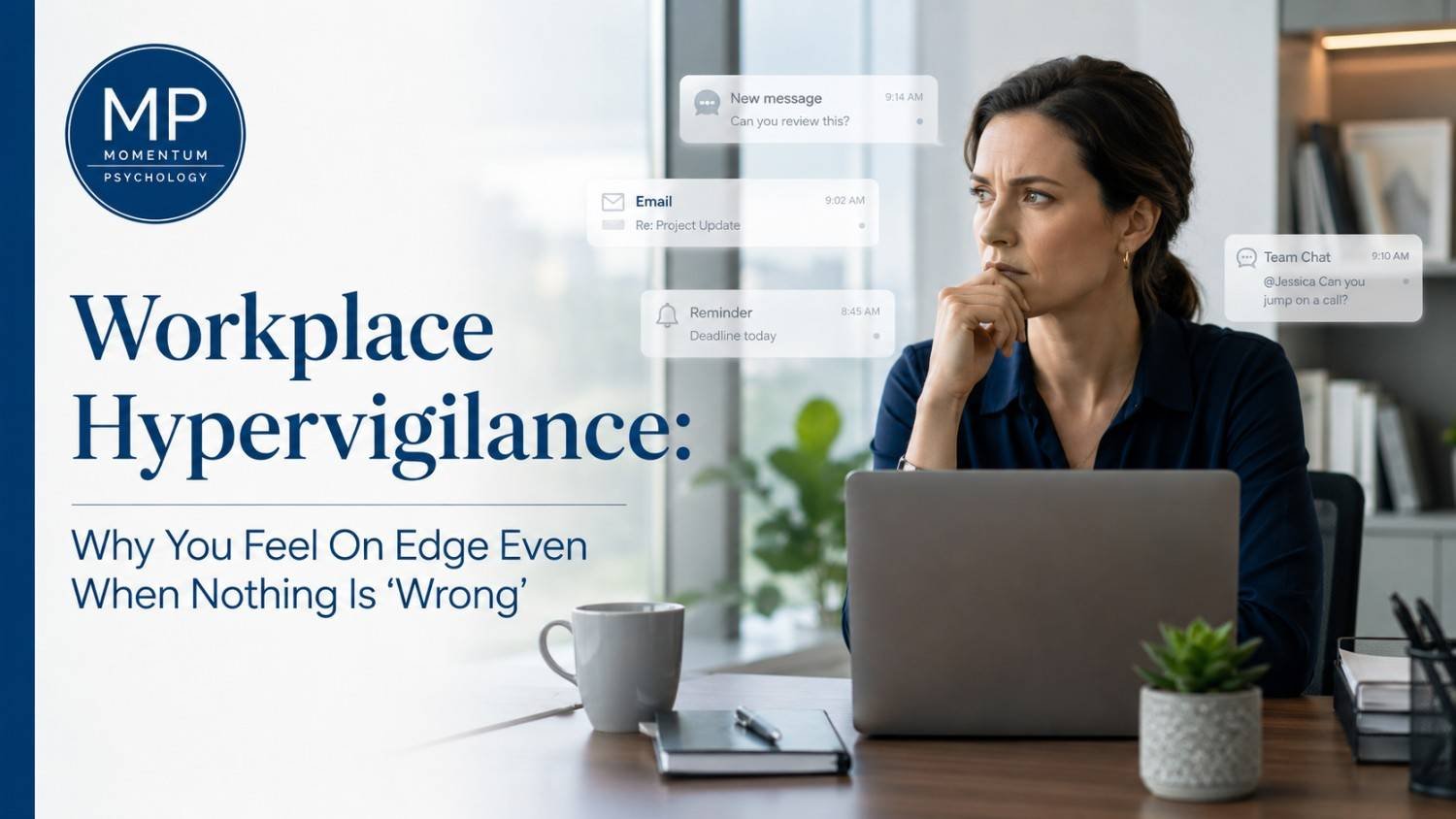
Workplace hypervigilance is a pattern of feeling constantly alert, tense, watchful, or braced for something to go wrong at work, even when there is no clear immediate threat. It can feel like waiting for criticism, conflict, mistakes, layoffs, disappointment, or sudden change. High-achieving professionals may be especially vulnerable because they are often trained to anticipate problems, perform under pressure, and stay responsible for outcomes. Momentum Psychology provides doctoral-level online therapy for high-achieving professionals dealing with anxiety, stress, burnout, trauma-related patterns, and workplace pressure.
This article is educational and not a substitute for care from a qualified mental health professional.
What Is Workplace Hypervigilance?
Workplace hypervigilance is a pattern of heightened alertness, scanning, tension, or threat monitoring in work settings. It is not the same as being responsible, detail-oriented, prepared, or conscientious.
A responsible professional prepares for a meeting. A hypervigilant professional may rehearse every possible way the meeting could go wrong, monitor everyone’s tone, read neutral comments as criticism, and leave exhausted even if nothing bad happened.
Hypervigilance is not automatically a diagnosis. It may overlap with anxiety, trauma responses, burnout, chronic stress, perfectionism, people-pleasing, ADHD, sleep deprivation, or genuinely unsafe work environments. The key issue is when your nervous system acts as if danger is present even when the current situation is relatively safe.
According to the National Institute of Mental Health, feeling tense, on guard, or on edge can appear among arousal and reactivity symptoms associated with PTSD. That does not mean everyone who feels hypervigilant at work has PTSD. It means persistent “on guard” feelings deserve careful attention, especially when they interfere with sleep, concentration, relationships, or daily functioning.
Why You May Feel On Edge Even When Nothing Is “Wrong”
Feeling on edge at work usually has a logic, even if the reaction feels excessive in the moment. Your nervous system may be responding to patterns it has learned from past experiences, current pressure, or both.
Possible contributors include:
- Past criticism, unpredictable leadership, layoffs, or toxic work environments
- High-stakes work where mistakes carry serious consequences
- Perfectionism and fear of disappointing others
- Chronic job insecurity
- Trauma history or relational wounds
- Burnout and nervous-system overload
- Ambiguous feedback or unclear expectations
- Constant digital availability
- High achievement culture
- Workplaces where silence, delay, or short messages often meant something was wrong
For high performers, workplace hypervigilance can hide behind excellence. You may be praised for being prepared, responsive, and careful, while privately feeling unable to relax. Momentum’s therapy for busy professionals is designed for adults who are capable and high-functioning on the outside but may be carrying anxiety, burnout, perfectionism, or chronic pressure internally.
Workplace stress is not rare. APA’s 2025 Work in America survey found that job insecurity had a significant impact on stress levels for 54% of U.S. workers. CDC data also shows that 12% of U.S. adults regularly reported feelings of worry, nervousness, and anxiety in 2024.
Workplace Hypervigilance vs Healthy Alertness
Healthy alertness helps you respond to real demands. Hypervigilance keeps you braced for danger even when the threat is unclear, exaggerated, or already past.
| Situation | Healthy Alertness | Workplace Hypervigilance Pattern |
| Preparing for a meeting | You review the agenda and clarify your role. | You rehearse every possible criticism and imagine the meeting going badly. |
| Reading a short email from your manager | You notice the message and respond if needed. | You assume the tone means disappointment, anger, or hidden conflict. |
| Receiving feedback | You consider what is useful and ask clarifying questions. | You feel exposed, ashamed, defensive, or certain you are failing. |
| Making a mistake | You correct it and learn from it. | You replay it for hours and fear it changed how others see you. |
| Hearing about layoffs | You update your awareness and consider practical next steps. | You doomscroll, assume you are next, and struggle to focus. |
| Taking time off | You prepare coverage and disconnect reasonably. | You feel guilty, monitor messages, and expect something to go wrong. |
| Seeing a colleague seem quiet | You allow for many possible explanations. | You assume they are upset with you or judging your work. |
| Checking work messages after hours | You check only when truly necessary. | You feel unable to stop checking because silence feels unsafe. |
The difference is not whether you care. The difference is whether your nervous system can stand down when the situation does not require emergency-level vigilance.
Common Signs of Workplace Hypervigilance
Workplace hypervigilance often shows up in small, repeated habits rather than one dramatic symptom.
You may notice:
- Reading neutral emails as threatening
- Rehearsing conversations repeatedly
- Feeling tense before meetings
- Checking messages compulsively
- Difficulty relaxing after work
- Assuming silence means disapproval
- Feeling startled by notifications
- Overexplaining to avoid criticism
- Monitoring other people’s tone or facial expressions
- Preparing for problems that never happen
- Avoiding rest because something might go wrong
- Feeling exhausted from staying “on”
- Feeling responsible for everyone’s mood
- Scanning for signs that your job, reputation, or relationships are at risk
- Feeling calm only after you have checked, clarified, overprepared, or pleased someone
If these patterns are persistent, anxiety therapy may help you understand the threat-monitoring loop and build more effective responses.
Why High-Achieving Professionals Are Vulnerable
High-achieving professionals are often rewarded for anticipating risk. They catch errors early. They prepare thoroughly. They notice subtle shifts. They take responsibility.
Those strengths can become costly when the nervous system never gets the message that work is over.
High achievers may confuse vigilance with excellence. They may believe relaxing means becoming careless. They may have built entire careers by being the person who catches problems before anyone else does.
That can create an internal rule:
“If I stop monitoring, something bad will happen.”
For lawyers, executives, physicians, entrepreneurs, students, managers, and consultants, this can be especially powerful. Their roles often involve high expectations, ambiguous feedback, constant evaluation, and visible consequences. Over time, the body may start treating ordinary work signals as potential danger.
The problem is not that you are weak. The problem is that a protection strategy may have become too expensive.
The Nervous System Loop: Threat, Control, Relief, Exhaustion
Workplace hypervigilance often strengthens through repetition.
Here is the loop:
- Something ambiguous happens at work.
- The brain interprets it as possible danger.
- You scan, check, overprepare, overexplain, or people-please.
- You feel short-term relief.
- The brain learns that hypervigilance kept you safe.
- The pattern becomes stronger.
- Exhaustion and burnout increase.
This is why hypervigilance can be hard to stop. It often “works” in the short term. You check the email. You prepare more. You clarify the tone. You avoid the mistake. Your anxiety drops.
But the long-term cost is high. Your nervous system learns that safety depends on constant monitoring.
That is where stress and burnout therapy may help. The goal is not to make you careless. The goal is to help you become more accurate: alert when needed, but not trapped in threat mode when the situation does not require it.
Research on hypervigilance has linked it to threat-focused attention and anxiety-maintaining feedback loops, especially in anxiety and PTSD-related models.
Is Workplace Hypervigilance a Trauma Response?
Workplace hypervigilance can be trauma-related for some people, but it is not always a trauma response.
It may happen after:
- workplace bullying
- unstable leadership
- sudden layoffs
- harassment or discrimination
- chronic criticism
- public humiliation
- betrayal by a manager or team
- earlier family, school, or relationship experiences where safety depended on reading the room
It can also occur with anxiety, chronic stress, burnout, ADHD, sleep deprivation, perfectionism, or high-pressure work environments. Sometimes the workplace is genuinely unstable, and your alertness is responding to a real pattern.
The point is not to self-diagnose from one article. The point is to ask a better question:
“Is my current level of alertness proportional to the current situation?”
A qualified mental health professional can help determine what is driving the pattern. Trauma-informed therapy may be especially useful when current work reactions feel connected to earlier experiences of threat, criticism, instability, or powerlessness.
What to Do When You Feel On Edge at Work
You do not need to shame yourself for being hypervigilant. You need tools that help your brain and body update the threat level.
Name the Trigger Before Solving It
Before reacting, name what happened.
Examples:
- “My manager sent a short message.”
- “A colleague did not respond.”
- “I made a small mistake.”
- “There is uncertainty about the team.”
- “I received feedback.”
Naming the trigger helps separate the event from the story your nervous system is building around it.
Separate Facts From Threat Stories
Try this quick split:
Fact: “My manager wrote, ‘Can we talk tomorrow?’”
Threat story: “I’m in trouble. They are disappointed. I may lose my job.”
The threat story may feel true, but feeling true is not the same as being proven.
Regulate Your Body Before Responding
When your body is activated, your thinking becomes narrower. Before sending the email, checking Slack again, or overexplaining, try:
- feet on the floor
- slow exhale
- unclench jaw and shoulders
- look around the room and name five neutral objects
- step away from the screen for two minutes
- drink water
- delay the response until your body is less activated
This is not “just relaxing.” It is giving your brain better conditions for judgment.
Create Boundaries With Notifications
Constant alerts train constant vigilance. Consider:
- turning off nonessential notifications
- using scheduled message-checking windows
- removing work apps from the home screen
- setting an after-work shutdown routine
- avoiding email checks in bed
The goal is not avoidance. The goal is to stop letting every notification act like an alarm.
Ask for Clarity Instead of Mind-Reading
Hypervigilance often fills gaps with danger.
Instead of assuming, ask:
- “Can you clarify what you need from me?”
- “Is this urgent or can it wait until tomorrow?”
- “What does success look like for this project?”
- “Are there specific concerns you want me to address?”
- “Would you like a brief update or a full review?”
Clarity reduces unnecessary threat scanning.
Practice “Good Enough” Preparation
For high achievers, preparation can become compulsive. Try defining the stopping point before you begin.
Example:
“I will prepare for 45 minutes, review the three most likely questions, and then stop.”
Good enough does not mean careless. It means proportional.
Build a Shutdown Ritual After Work
Your body may need a signal that work is over.
A shutdown ritual might include:
- writing tomorrow’s top three priorities
- closing all work tabs
- turning off notifications
- taking a short walk
- changing clothes
- doing a five-minute breathing or grounding practice
- saying, “Work is complete enough for today.”
Repetition matters. Your nervous system learns through practice.
Use Values Instead of Fear as Your Guide
Fear asks, “How do I prevent all criticism, risk, and uncertainty?”
Values ask, “What kind of professional and person do I want to be, even when uncertainty is present?”
Momentum’s work with Acceptance and Commitment Therapy often focuses on values-based action: doing what matters without waiting for discomfort to disappear first.
Get Support When the Pattern Is Persistent
If workplace hypervigilance is affecting sleep, relationships, performance, health, or your ability to rest, support matters. This may include therapy, medical care, coaching, mentorship, workplace advocacy, or practical changes to the work environment.
A Practical Reset Plan for Workplace Hypervigilance
| Moment | What Hypervigilance Says | Better Response | Why It Helps |
| A manager sends “Can we talk?” | “I’m in trouble.” | “I do not know yet. I can ask what they want to discuss.” | Separates uncertainty from catastrophe. |
| A colleague seems short | “They are upset with me.” | “There are many possible explanations. I can wait or clarify.” | Reduces mind-reading. |
| You make a small mistake | “This proves I’m failing.” | “This is a mistake to repair, not an identity verdict.” | Keeps the event proportional. |
| You receive feedback | “I disappointed them.” | “Feedback is information. I can extract what is useful.” | Lowers shame and defensiveness. |
| You see layoff news | “I’m next.” | “This is concerning. I can update my plan without spiraling.” | Converts threat into strategy. |
| You are trying to rest after work | “Something might go wrong.” | “Rest is part of sustainable performance.” | Interrupts over-responsibility. |
When Workplace Hypervigilance May Be a Sign to Seek Therapy
Therapy may help when the pattern becomes persistent, costly, or hard to interrupt alone.
Consider support if:
- Sleep is affected
- You cannot relax after work
- Normal work situations feel unsafe
- You are overworking or people-pleasing compulsively
- You are having panic symptoms
- You feel emotionally numb or detached
- You avoid feedback, meetings, rest, or boundaries
- Past trauma or toxic work experiences feel activated
- Your relationships are affected by irritability, withdrawal, or constant work monitoring
For some high-achieving professionals, online therapy can make support easier to access because sessions can fit around demanding schedules. Workplace hypervigilance can also affect communication, boundaries, and trust, which may connect with therapy for relationship stress.
How Therapy Can Help High-Achieving Professionals Feel Less On Guard
Therapy does not promise to remove all stress or uncertainty. That would not be realistic. Instead, therapy can help you build a more flexible relationship with threat, responsibility, and control.
Therapy may help you:
- Identify threat-monitoring patterns
- Reduce rumination and mind-reading
- Build nervous-system regulation skills
- Improve boundaries
- Separate real risk from old alarm responses
- Address perfectionism and people-pleasing
- Process trauma-related patterns if relevant
- Build tolerance for uncertainty
- Reconnect with values-based action
CBT may help identify catastrophic interpretations. ACT may help build values-based action under discomfort. DBT-informed skills may support emotional regulation. Trauma-informed therapy may help when current reactions are connected to past experiences. Mindfulness and somatic grounding may help calm physiological arousal before responding.
The goal is not to become indifferent. The goal is to become less controlled by alarm.
Final Thoughts: You Do Not Have to Live on High Alert
Workplace hypervigilance is not a character flaw. It is often a learned protection strategy that may have helped you stay prepared, avoid criticism, or survive unstable environments. But if that strategy now keeps you tense, exhausted, reactive, or unable to rest, it may be costing more than it gives.
Workplace hypervigilance can improve when you learn to separate facts from threat stories, regulate your body before reacting, set better boundaries, and get support for anxiety, burnout, trauma-related patterns, or perfectionism. Momentum Psychology provides doctoral-level online therapy for high-achieving professionals who want practical, evidence-based support for workplace pressure and life beyond work. If feeling on edge at work is affecting your sleep, focus, relationships, or quality of life, you can start therapy.
FAQs About Workplace Hypervigilance
What is workplace hypervigilance?
- Workplace hypervigilance is a pattern of feeling constantly alert, tense, or on guard at work, even when there is no clear immediate threat. It may involve scanning for criticism, conflict, mistakes, rejection, or sudden change. It is not automatically a diagnosis, but it can become disruptive.
Why do I feel on edge at work even when nothing is wrong?
- You may feel on edge because your nervous system has learned to expect danger, criticism, instability, or disappointment at work. This can come from current workplace stress, past criticism, burnout, perfectionism, trauma-related patterns, or unclear expectations. The reaction often has a reason, even when the present moment is safe.
Is workplace hypervigilance the same as anxiety?
- Workplace hypervigilance and anxiety can overlap, but they are not identical. Anxiety often involves worry about future events. Hypervigilance is more specifically a threat-monitoring pattern where your attention scans for signs of danger. Many people experience both at the same time.
Is workplace hypervigilance a trauma response?
- Workplace hypervigilance can be trauma-related for some people, especially after bullying, harassment, sudden layoffs, chronic criticism, or earlier experiences of instability. It can also occur with anxiety, burnout, ADHD, sleep deprivation, or high-pressure work. A qualified professional can help identify what is driving it.
What are signs of hypervigilance at work?
- Signs may include reading neutral emails as threatening, rehearsing conversations, checking messages compulsively, feeling tense before meetings, assuming silence means disapproval, overexplaining, monitoring tone or facial expressions, and feeling exhausted from staying “on.” The pattern often continues even when performance is strong.
How can I calm my nervous system during work?
- Start by naming the trigger, slowing your breathing, relaxing your jaw and shoulders, and separating facts from threat stories. You can also step away from the screen briefly, ask for clarity instead of mind-reading, and set boundaries with notifications. Small resets work best when practiced repeatedly.
Can therapy help with workplace hypervigilance?
- Therapy may help by identifying threat-monitoring patterns, reducing rumination, building nervous-system regulation skills, improving boundaries, and addressing anxiety, perfectionism, burnout, or trauma-related responses. Therapy does not remove all workplace stress, but it can help you respond with more flexibility and clarity.
When should I seek help for feeling constantly on guard at work?
- Consider seeking help when feeling on guard affects sleep, focus, relationships, performance, or your ability to rest. Support may also be important if you feel unsafe in ordinary work situations, have panic symptoms, overwork compulsively, avoid feedback, or feel emotionally numb or detached.