
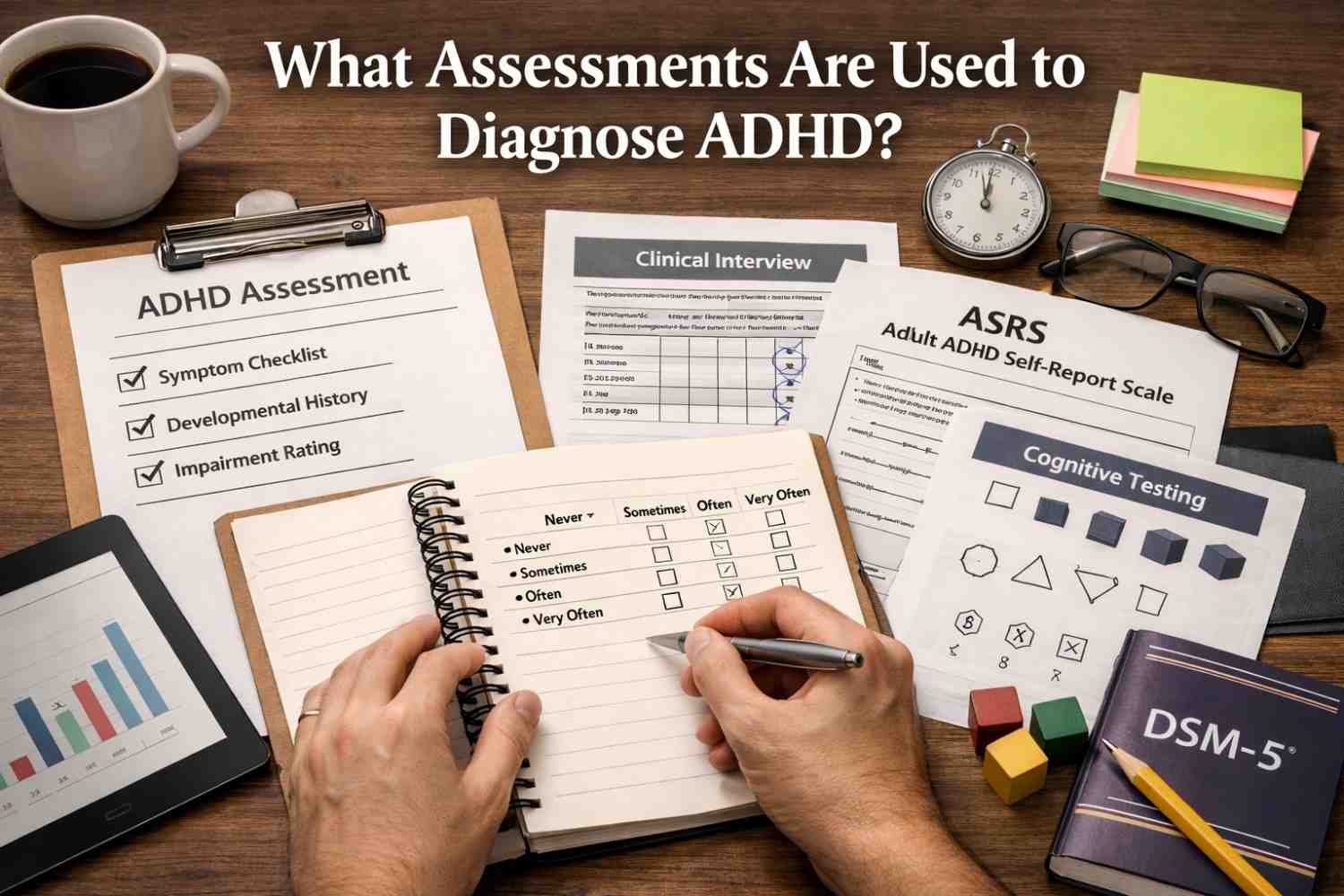
ADHD is not diagnosed with one quiz, one brain scan, or one short conversation. A proper evaluation usually includes a detailed clinical interview, a review of symptoms over time, rating scales, developmental history, evidence that symptoms affect daily life, and screening for other conditions that can look like ADHD. If you are trying to understand whether ADHD is the right explanation for your struggles with focus, planning, follow-through, restlessness, or mental overload, a comprehensive adult ADHD assessment can offer much more clarity than a simple screener ever could.
For many adults, the question is not just “Do I have ADHD?” It is also “Why has this felt so hard for so long?” Some people have always felt different but managed to compensate with intelligence, pressure, perfectionism, or long hours. Others notice the problem when life becomes more demanding in college, work, parenting, or leadership roles. If that sounds familiar, it may also help to read about ADHD symptoms that often go unnoticed by adults.
Read more: Is it Time to Consult an Anxiety Therapist? Signs You Shouldn’t Ignore
The Short Answer: There Is No Single Test for ADHD
One of the biggest misunderstandings about ADHD is the idea that there is one definitive test that can confirm it. There is not. ADHD is a clinical diagnosis, which means clinicians look at the full picture rather than relying on one data point. According to the CDC, there is no single test to diagnose ADHD. That matters because many other issues can create similar symptoms, including anxiety, depression, trauma, sleep problems, learning differences, stress, burnout, and some medical concerns.
That is why a good evaluation is designed to answer two questions at once:
- Do your symptoms fit ADHD?
- Is ADHD the best explanation for what is happening?
- Are there other conditions contributing to the problem?
- Is ADHD part of the picture, but not the whole picture?
Sometimes the answer is yes. Sometimes it is more complicated. That is exactly why a thorough assessment matters.
Read more: Managing Anxiety: Therapeutic Techniques for Success
What Clinicians Usually Look for in an ADHD Evaluation
1. A Detailed Clinical Interview
A real ADHD assessment starts with a detailed conversation, not a checklist alone. The clinician will usually ask about:
- Current symptoms
- Childhood history
- School experiences
- Work performance
- Family patterns
- Relationships
- Mental health history
- Coping strategies
- Situations where the problems show up most clearly
In adults, that often means looking closely at missed deadlines, chronic overwhelm, difficulty prioritizing, mental restlessness, inconsistency, procrastination, and the amount of effort it takes to stay organized.
This is one reason many people who are successful on paper still end up seeking answers later. High achievement does not rule out ADHD. In fact, some adults spend years masking symptoms until increasing demands make the cost of compensation too high. If that resonates, Momentum’s page on therapy for high performers may also feel relevant.
2. A Review of DSM-Based Symptoms
Clinicians also compare your experience to formal diagnostic criteria. In adults, ADHD symptoms must be persistent, begin in childhood, and create meaningful impairment in more than one setting. According to the American Psychiatric Association, diagnosis is based on persistent symptoms over time, with signs beginning in childhood and showing up in more than one setting.
That means ADHD is not just about being distractible sometimes. The pattern has to be:
- Broader
- More consistent
- More impairing
- Present across different parts of life
3. Functional Impairment Across Settings
ADHD is not diagnosed only because someone relates to a list of symptoms. The symptoms also have to affect real life.
For example, clinicians may look at whether symptoms affect:
- Work
- School
- Relationships
- Home responsibilities
- Time management
- Daily planning
- Financial organization
- Parenting responsibilities
A person may be bright, motivated, and deeply capable, yet still struggle to translate effort into consistent output.
If work has become the clearest place where symptoms show up, you may also want to read managing ADHD in the workplace.
4. Rating Scales and Questionnaires
Rating scales are commonly used in ADHD evaluations because they help organize information and compare symptom patterns to recognized criteria. But they are not meant to stand alone. They are tools that support the assessment, not replacements for clinical judgment.
These tools can help identify:
- Inattention
- Hyperactivity
- Impulsivity
- Executive functioning struggles
- Daily impairment
- Symptom severity
In adults, clinicians may use screeners or symptom scales to better understand current functioning. In children and teens, parent and teacher forms are often especially important.
5. Developmental History and Collateral Information
ADHD begins in childhood, even if it is not recognized until adulthood. That is why evaluations often include questions about early functioning, school habits, behavior patterns, and family observations.
Adults who were never diagnosed as children may still be able to describe long-term patterns such as:
- Chronic forgetfulness
- Daydreaming
- Restlessness
- Careless mistakes
- Unfinished tasks
- Intense procrastination
- Difficulty regulating effort
Sometimes clinicians also gather collateral information from:
- Parents
- Partners
- Teachers
- Report cards
- Academic records
- Other trusted sources
That does not mean a person cannot describe their own experience. It means ADHD often becomes clearer when current struggles and long-term history line up.
6. Screening for Other Conditions That Can Look Like ADHD
This is where strong evaluations separate themselves from superficial ones. Difficulty focusing does not automatically mean ADHD.
Other conditions that can overlap with ADHD symptoms include:
- Anxiety
- Depression
- Trauma
- Sleep problems
- Learning disorders
- Burnout
- Chronic stress
- Substance use
- Some medical issues
If anxiety is part of the picture, it may help to explore anxiety therapy alongside an assessment process. Some people discover they have ADHD with anxiety. Others learn that anxiety, burnout, or another issue is driving the symptoms more than ADHD is.
Read more: Navigating Entrepreneurial Anxiety: Therapy Solutions
Common Assessments Used to Diagnose ADHD in Adults
Adults often search for the name of a specific test, but adult ADHD diagnosis is usually built from a combination of methods rather than one stand-alone measure.
Adult ADHD Self-Report Scale (ASRS)
The ASRS is one of the better-known adult ADHD screening tools. It can help identify whether a person has a pattern of symptoms consistent with ADHD and whether a fuller evaluation makes sense.
It can be useful because it helps screen for:
- Attention difficulties
- Restlessness
- Follow-through problems
- Organization struggles
- Symptom frequency
But it is still a screener, not a diagnosis by itself.
Structured Diagnostic Interviews
Many clinicians use structured or semi-structured interviews during adult ADHD evaluations. These interviews are designed to:
- Walk through ADHD criteria carefully
- Review childhood and adult symptoms
- Examine impairment across life areas
- Look for consistency over time
- Distinguish ADHD from other conditions
Structured interviews are especially valuable when someone is:
- Bright
- High-performing
- Anxious
- Perfectionistic
- Used to masking symptoms
Those are exactly the cases where a quick surface-level approach can miss important nuance.
Rating Scales, Executive Functioning Measures, and Clinical Judgment
Depending on the case, clinicians may also use rating scales focused on:
- Executive functioning
- Attention patterns
- Emotional regulation
- Daily impairment
- Cognitive organization
Sometimes extra psychological or neuropsychological testing is added when:
- The picture is complicated
- Multiple conditions may overlap
- Learning issues are also suspected
- The history is unclear
- There is a need for added diagnostic clarity
If you want a broader overview of how these options fit together, see Momentum’s pages on ADHD testing, ADHD diagnosis for adults, and online ADHD testing.
Read more: Cultivating Success: Anxiety Therapy for High Achievers
Common Assessments Used in Children and Teens
Even though this article is especially relevant for adults who are questioning ADHD for the first time, it helps to understand how child and teen evaluations are often approached, because the overall logic is similar.
The clinician still looks for:
- Symptoms
- Impairment
- Developmental history
- Consistency across settings
Parent and Teacher Rating Scales
For children and adolescents, parent and teacher forms are often central because they capture what symptoms look like in different environments.
According to the American Academy of Pediatrics, ADHD evaluation in children and adolescents should include reports from parents and school staff, along with information from the young person when appropriate.
Common child and teen tools may include:
- Vanderbilt scales
- Conners rating scales
- Parent behavior reports
- Teacher behavior reports
- Academic history
- School performance patterns
These tools support the assessment, but they do not replace a full clinical evaluation.
School, Behavior, and Developmental History
Clinicians also look at:
- Academic performance
- Teacher comments
- Behavior patterns
- Developmental milestones
- Attention across subjects and settings
- Family observations over time
For some children, the symptoms are obvious early. For others, especially bright or compliant children, the signs may be missed until demands increase.
Read more: Cultivating Success: Anxiety Therapy for High Achievers
What Does Not Diagnose ADHD by Itself
This is the section many readers need most.
The following do not diagnose ADHD on their own:
- An online quiz
- One rating scale
- One attention problem during a stressful season
- A social media checklist
- A short conversation without history
- A single symptom list
- High stress alone
- Poor sleep alone
It is also important to know what ADHD diagnosis is not based on by itself:
- One checklist
- One observation
- One bad semester
- One burnout period
- One viral post that feels relatable
According to NICE, ADHD should not be diagnosed solely on the basis of rating scales or observational data. Those tools are useful, but they are not enough on their own.
This is one reason people often feel confused after taking online screeners. A screener can be a useful first step, but it cannot sort out:
- Whether ADHD is the most accurate explanation
- Whether another issue better explains the symptoms
- Whether multiple issues are interacting at the same time
Read more: Balancing Brilliance: Anxiety Therapy for High Achievers
What a Comprehensive Adult ADHD Assessment Should Include
If you are considering an evaluation, it helps to know what a solid process should feel like. It should be thorough enough to give you confidence in the answer, whether the answer is ADHD or not. It should not feel rushed, simplistic, or built around a single form.
A comprehensive adult ADHD assessment will often include:
- A detailed intake and symptom review
- Questions about childhood history and developmental patterns
- Screening for anxiety, depression, trauma, sleep issues, and other overlapping concerns
- Rating scales or structured interviews
- Review of impairment at work, school, home, or in relationships
- Collateral information when useful
- Clear feedback about what the findings do and do not support
That is the kind of approach reflected in Momentum’s pages on adult ADHD assessment, ADHD diagnosis for adults, and neurodiversity assessment.
The goal is not only to give someone a label. It is to help them understand their mind more accurately and choose the next step with confidence.
Read more: Academic Anxiety and The Importance of Therapy for Students
When It Makes Sense to Seek a Professional ADHD Evaluation
You do not need to be in full crisis to benefit from assessment. In fact, many adults seek evaluation not because life is falling apart, but because it takes too much effort to keep things together.
You may want a formal ADHD assessment if:
- You constantly feel behind, even when you are working hard
- Your focus varies dramatically depending on interest, urgency, or pressure
- You struggle with time blindness, follow-through, or task initiation
- You rely on last-minute panic to get things done
- You have always felt mentally busy or restless
- You suspect anxiety or burnout may be hiding something deeper
- You want a clearer explanation before pursuing treatment, coaching, or accommodations
It may also help to read what ADHD is and why it is often misunderstood, especially if your experience has been dismissed because you are capable, articulate, or successful.
Read More: Light Therapy for Depression and Anxiety: Common Mistakes and How to Avoid Them
What Happens After an ADHD Diagnosis?
A diagnosis is not the end of the conversation. It is the beginning of a more accurate one.
For some people, diagnosis brings relief because years of self-criticism finally start to make sense. For others, the most helpful part is not the label itself, but the roadmap that follows.
That roadmap may include:
- Therapy
- Coaching
- Medication discussions with a prescriber
- Academic accommodations
- Workplace accommodations
- Executive functioning support
- Lifestyle adjustments
- Better systems for organization and follow-through
Just as important, a careful assessment can also tell you when ADHD is not the best explanation. That can save people from going down the wrong path and help them focus on the issue that actually needs attention.
Read more: What Is the Goal of Acceptance and Commitment Therapy? A Simple, Evidence-Based Guide
FAQs About ADHD Assessment
Can ADHD be diagnosed with one test?
- No. ADHD is not diagnosed with one test. Clinicians typically use a combination of interview, symptom review, rating scales, developmental history, impairment data, and screening for other possible explanations.
Is an online ADHD quiz enough for a diagnosis?
- No. An online quiz may work as a screener, but it cannot confirm ADHD by itself. It cannot rule out anxiety, depression, trauma, sleep problems, or other issues that can look similar.
What assessment is used most often for adult ADHD?
- There is no single universal assessment. Many adult evaluations use a clinical interview, adult rating scales such as the ASRS, and structured diagnostic interviews alongside a review of history and impairment.
Are rating scales useful?
- Yes. Rating scales can be very useful, especially when combined with a strong clinical interview and collateral information. The mistake is treating them as a full diagnosis by themselves.
Do you need childhood symptoms for an ADHD diagnosis?
- Yes. ADHD begins in childhood, even if it is not recognized until adulthood. Adults do not need to have been diagnosed as children, but the evaluation should still find evidence that symptoms were present earlier in life.
Can anxiety look like ADHD?
- Yes. Anxiety can interfere with attention, memory, follow-through, and mental clarity. That is why good ADHD evaluations also screen for anxiety and other overlapping conditions.
Do successful adults still get diagnosed with ADHD?
- Absolutely. Many adults with ADHD are intelligent, driven, and capable. Success does not rule ADHD out. It may simply mean they have spent years compensating in ways that are exhausting to maintain.
What is the difference between screening and diagnosis?
- Screening identifies whether ADHD might be worth evaluating. Diagnosis is a broader clinical process that determines whether ADHD actually fits the full picture better than other possible explanations.