
If anxiety is mild, recent, and not shrinking your life, start with a DIY plan: pick one anxiety pattern, run one weekly “experiment,” and track two numbers. If anxiety is persistent, impairing, panic-driven, trauma-linked, or not improving with self-help, it’s time to work with a clinician—because the highest-yield therapies (like CBT and exposure-based work) are structured skill-building, not just “talking about it.”
This article gives you:
- A DIY vs. Get Help decision table
- A 10-minute pre-session plan (what to bring into therapy)
- A session agenda template (what to focus on)
- A between-session plan that actually drives change
- Copy/paste scripts you can use in session
Educational only—not medical advice. If you’re in immediate danger or at risk of harming yourself, contact local emergency services right now.
Read more: Is it Time to Consult an Anxiety Therapist? Signs You Shouldn’t Ignore
Step 1 — The 60-second decision: DIY lane or “get help” lane?
Here’s the cleanest way to decide: DIY is for skill practice when risk is low. Therapy is for precision, accountability, exposure design, and complex factors.
DIY is reasonable when…
- Symptoms are mild to moderate, and you can still do school/work/relationships.
- Anxiety is situational (one theme), not “everything everywhere.”
- You can commit to small weekly behavior tests (not just reading tips).
- You’ve tried some basics, and you’re seeing small improvement month to month.
Get help when…
The NHS puts it plainly: seek help when you’re struggling to cope or what you’re trying yourself isn’t helping.
Also consider professional support when you have:
- Frequent panic, severe physical symptoms, or constant dread
- Anxiety + depression, OCD, trauma, substance use, or eating issues (these often change the plan)
- Strong avoidance (your life is getting smaller)
- Sleep collapse, work impairment, relationship impact
- Any safety concern
Read more: Managing Anxiety: Therapeutic Techniques for Success
DIY vs Get Help decision table (one-glance)
| Question | DIY lane (try 2–4 weeks) | Get help lane (book consult) |
| Is life still functioning? | Mostly yes | No—work/school/relationships slipping |
| Is anxiety specific? | One main trigger loop | Many domains or “all day” anxiety |
| Can you change behavior weekly? | Yes | No—avoidance/panic blocks attempts |
| After 2–4 weeks, is it improving? | Yes, even slightly | No change / worse |
Step 2 — What “therapy session focus” actually means (one sentence)
A good anxiety session focuses on one maintaining loop (trigger → threat story → body alarm → avoidance/safety behavior), then designs one test to weaken that loop before the next session.
Momentum Psychology summarizes the CBT mechanism like this: trigger → appraisal → attention → arousal → avoidance/safety behaviors → short-term relief → long-term maintenance.
That’s the core: insight helps, but behavior change teaches your brain. CBT is widely recognized as an evidence-based treatment approach for anxiety.
Read more: Navigating Entrepreneurial Anxiety: Therapy Solutions
Step 3 — The “3×3” session structure that keeps therapy from drifting
Most people waste therapy time because sessions turn into weekly venting with no plan. Your fix is a simple structure.
Part A (3 minutes): Two-number dashboard
Pick two numbers and track weekly:
- Avoidance minutes (time you avoided/delayed because of anxiety)
- Reassurance checks (texts, googling symptoms, asking others, re-reading)
This mirrors the “measure what maintains anxiety” idea used in CBT planning.
Part B (3 minutes): Name the week’s “target loop”
Use this sentence:
- “This week, my anxiety shows up most when ________. I cope by ________ (avoidance/safety behavior). I want to change ________.”
Examples:
- “Before meetings, I catastrophize; I cope by over-preparing and seeking reassurance.”
- “In social events, I monitor my face/voice; I cope by leaving early.”
Part C (20–30 minutes): Skill + in-session practice
Effective anxiety therapy is typically skills-based and structured (CBT and exposure are the obvious examples).
Your session should include practice, not only discussion.
Part D (5 minutes): Write the experiment (your “between-session” plan)
Why this matters: meta-analyses show homework adherence correlates with better outcomes in CBT and related approaches (small-to-medium relationship overall).
Translation: the week matters as much as the hour.
Read more: Cultivating Success: Anxiety Therapy for High Achievers
Step 4 — Copy/paste: a session agenda you can use every time
If you want your therapist to “focus the session,” give them this agenda at the start.
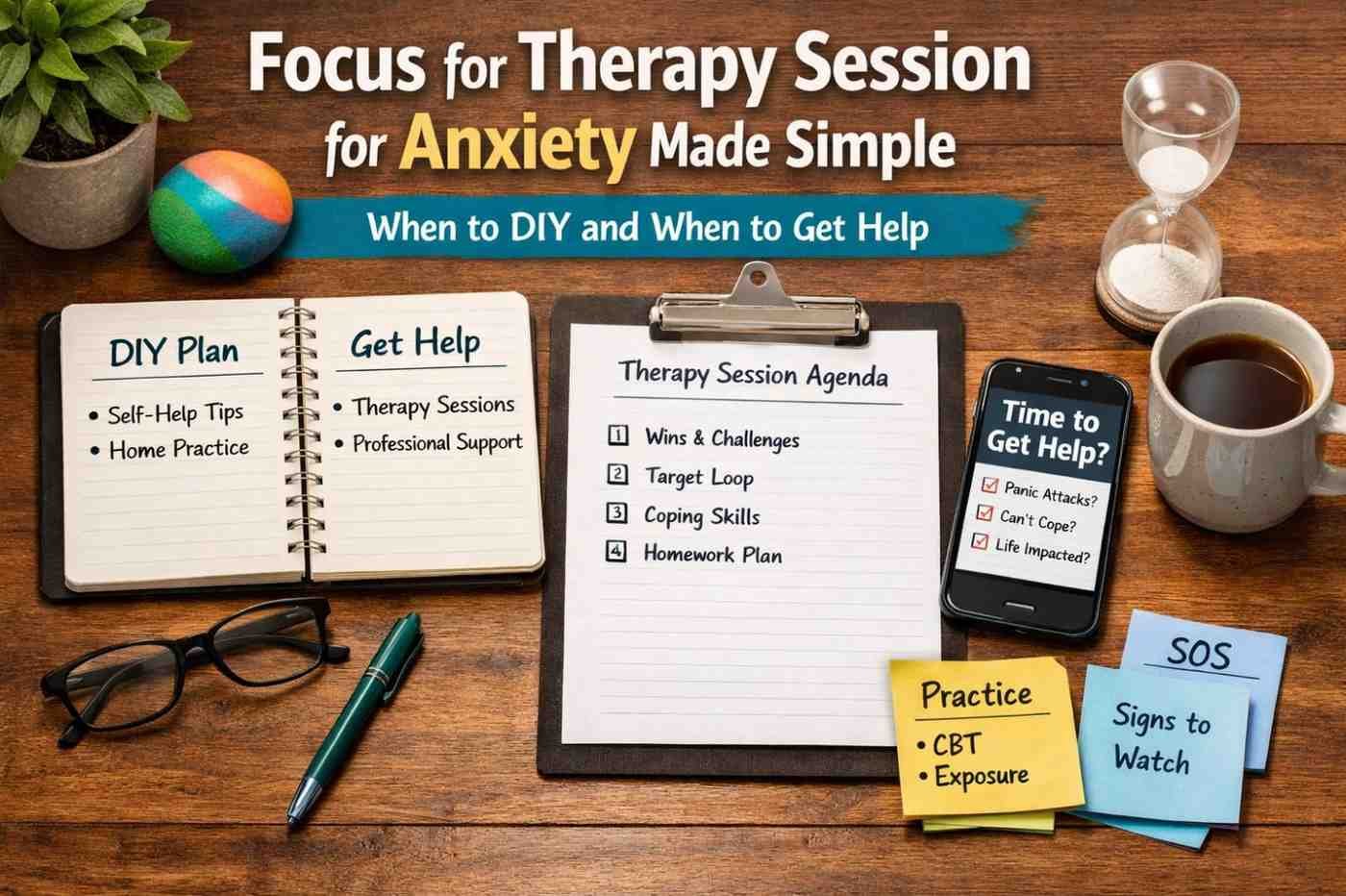
Therapy Session Agenda (copy/paste)
- One win + one stuck point from last week
- Two numbers: avoidance minutes ___ / reassurance checks ___
- One target loop: trigger → story → body → behavior
- Today’s goal: design 1 experiment + 1 coping skill
- Between-session plan: what, when, where, how long, what I’ll measure
Session agenda tools are commonly used in CBT-oriented work to keep sessions aligned with skill-building.
Read more: Balancing Brilliance: Anxiety Therapy for High Achievers
Step 5 — The experiment card (this is what “progress” looks like)
A great anxiety session ends with a testable prediction—not a motivational quote.
Experiment Card (copy/paste)
- Situation: (What I’ll do)
- Prediction (0–100%): “If I do this, ______ will happen.”
- Safety behavior to drop/thin: (one thing)
- What I’ll measure: (interruptions, heart rate checking, reassurance texts, minutes avoided, etc.)
- Result: (what actually happened)
- New learning: (what changed in the prediction)
Momentum’s CBT guidance emphasizes moving from “talking about thoughts” to behavioral experiments tied to predictions, and watching safety behaviors closely.
Read more: Academic Anxiety and The Importance of Therapy for Students
Step 6 — “DIY therapy session focus”: what you can safely do on your own
DIY can work when you treat it like training, not like reading.
The DIY minimum viable plan (14 days)
Daily (5 minutes)
- Write the day’s one loop: trigger → story → behavior
- Choose one tiny opposite action (e.g., send the email without rereading 10 times)
Twice per week (15 minutes)
- Run one experiment card (above)
- Track your two numbers
Once per week (10 minutes)
- Review: What shrank avoidance? What fed reassurance loops?
If you want a clinical north star: CBT is structured and skills-based; self-help works best when it imitates that structure rather than staying motivational.
Read more: Therapy for Entrepreneurs: Addressing Anxiety and Stress
Step 7 — When “get help” becomes the smart move (not the dramatic move)
People wait too long because they think therapy is only for crisis. It’s not.
Use therapy when you need:
- Exposure design (you keep avoiding, or exposures backfire)
- Precision (you’re doing “CBT-ish” but plateauing)
- Comorbidity navigation (trauma/OCD/depression/ADHD changes the plan)
- Progress monitoring (you need an outside system)
Momentum Psychology explicitly pushes the idea that plateaus often come from process errors (safety behaviors, attentional bias, reassurance loops, lack of metrics), not lack of willpower.
What to say when you book (copy/paste)
- “My anxiety is impacting ________. I’ve tried ________. I want CBT/exposure-style treatment with clear goals and progress tracking.”
A strong therapist will welcome questions about evidence, training, and how progress is assessed.
If you want a structured plan (not just coping tips), Momentum Psychology focuses on evidence-based approaches commonly used for anxiety—like CBT and exposure-based work—plus clear progress tracking so sessions stay practical and targeted. A good first step is a consult where you clarify goals, what methods will be used, and how improvement will be measured.
Read more: Anxiety Therapy: Techniques for Daily Life
FAQs
What should I focus on in an anxiety therapy session?
- Focus on one anxiety loop and end with one written experiment for the week (prediction, behavior test, metric). That’s how structured CBT-style work stays effective.
What if I don’t know what to talk about in therapy?
- Bring a simple agenda: one win, one stuck point, two numbers (avoidance + reassurance), one target loop, and one goal for today. A session agenda keeps therapy from drifting.
Can I DIY anxiety treatment without a therapist?
- Sometimes—if symptoms are mild and you can still function. DIY works best when it includes behavior change + tracking, not just reading or journaling. If self-help isn’t improving things, step up to professional care.
Why do therapists assign homework for anxiety?
- Because practice between sessions predicts better outcomes. Meta-analyses show a consistent relationship between homework adherence and improvement in CBT.
How do I know if therapy is “working” for anxiety?
- Your avoidance and reassurance loops shrink, and you’re doing more of what anxiety used to block. You should also see clearer goals and progress monitoring over time in structured care.